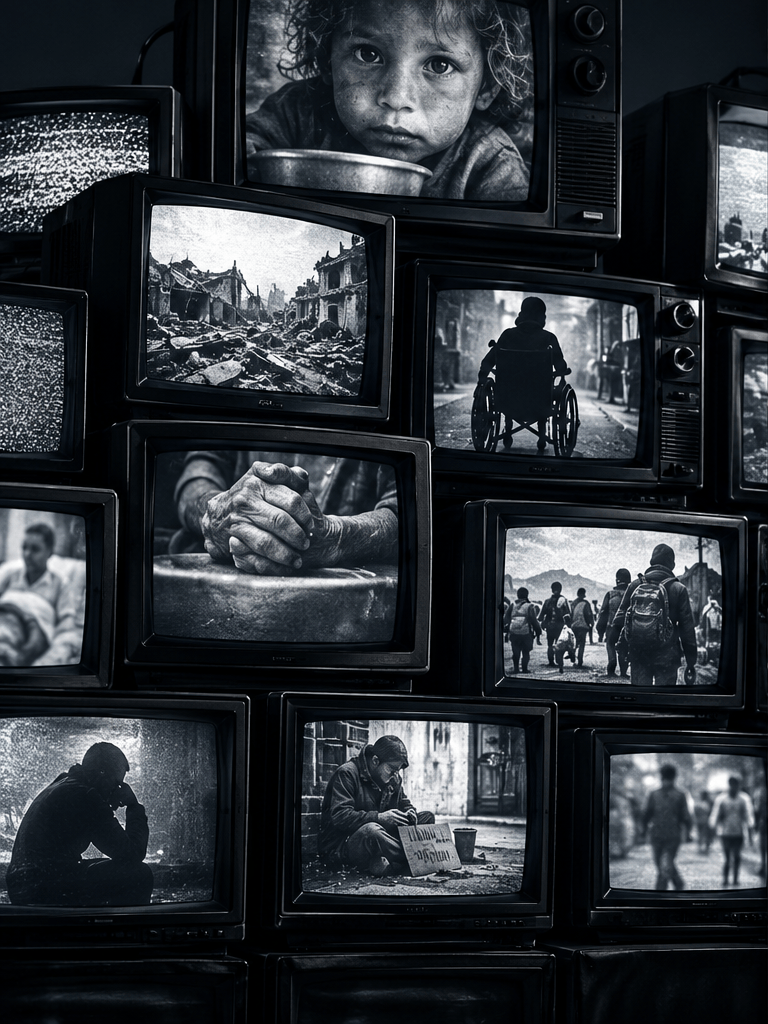
On poverty porn, disability, and the strange business of selling human suffering
There is a term in journalism called poverty porn.
It’s not particularly flattering, but neither is the practice it describes.
The term refers to the way human suffering is sometimes packaged, sensationalized, and sold to an audience hungry for an emotional reaction. Hungry children. Struggling families. Devastated communities. People living in circumstances most of us would prefer to believe exist somewhere far away from our own comfortable lives.
We watch. We gasp. We cry. We share.
Sometimes we donate five dollars. Sometimes we leave a heart emoji. Sometimes we write a passionate comment about how somebody really ought to do something.
And then we scroll on.
There’s something fascinating about our collective appetite for tragedy. We seem simultaneously horrified by human suffering and completely unable to look away from it.
Perhaps it’s compassion. Perhaps it’s curiosity. Perhaps it’s the peculiar comfort of watching someone else’s life fall apart while sitting safely inside our own.
Whatever the motivation, one thing is certain: suffering sells.
And lately, I’ve started wondering whether we’ve simply given poverty porn a modern makeover.
This time, it comes with a wheelchair, a hospital bracelet, a ring light, and a sponsorship deal.
The New Economy of Inspiration
Social media has created an entirely new marketplace for human experience, and disability has become one of its more complicated commodities.
There are videos of people learning to walk again, documenting their medical treatments, navigating relationships, and demonstrating how they accomplish ordinary tasks with extraordinary physical limitations.
Some are funny. Some are heartbreaking. Some are genuinely educational.
And some seem suspiciously designed to remind the rest of us how fortunate we are to have functioning legs.
The comments are almost predictable.
“You’re so inspiring!”
“I could never be as strong as you!”
“This really puts my problems into perspective!”
Which is lovely, I suppose, although I sometimes wonder whether the person simply trying to make breakfast intended to become someone else’s daily gratitude exercise.
There is an important distinction between appreciating someone’s resilience and turning their existence into a motivational poster.
Disabled people are not here to make everyone else feel better about their circumstances.
And yet, somewhere between the inspirational background music and the affiliate links, we’ve developed a remarkably profitable industry around exactly that idea.
To be clear, I don’t begrudge disabled creators their success.
Quite the opposite.
If someone can turn their experiences into financial independence, educational opportunities, and meaningful advocacy, good for them.
Frankly, after seeing what medical equipment, rehabilitation, transportation, and caregiving cost, I can hardly blame anyone for wanting a piece of the advertising revenue.
The healthcare system has already found approximately seventeen different ways to make money from a disabled body. It seems only fair that the person living inside it might get a turn.
But the cultural implications are worth examining.
What happens when the algorithm begins deciding which kinds of suffering deserve attention?
We Love a Good Tragedy. Solutions Are Less Entertaining.
Americans have a peculiar relationship with suffering.
We love stories about people overcoming impossible odds.
We love the single mother working three jobs, the veteran overcoming catastrophic injuries, the child raising money for a classmate’s medical bills, and the wheelchair user accomplishing something doctors said would never be possible.
We share these stories as evidence of the extraordinary human spirit.
And sometimes they are.
But occasionally, I find myself wondering why we are so determined to celebrate people’s ability to survive circumstances we have collectively decided not to fix.
A child selling lemonade to pay for a parent’s medical treatment makes a heartwarming news segment.
A serious discussion about why the family needs a lemonade stand to afford medical care is considerably less popular.
A disabled veteran climbing a mountain makes an excellent inspirational headline.
A disabled veteran spending months fighting for necessary services doesn’t quite have the same cinematic appeal.
We love resilience.
We seem considerably less enthusiastic about examining why so much resilience is required in the first place.
And this is where things get political, although perhaps not in the way people expect.
One side may call it personal responsibility. Another may call it systemic injustice. Both will undoubtedly find a way to use the story in a fundraising email.
Meanwhile, the person at the center of the story still needs a wheelchair-accessible vehicle.
There’s something almost impressive about our ability to turn another person’s hardship into a debate about our own beliefs.
We argue about government spending while praising private charity. We celebrate independence while making the tools required for independence financially inaccessible. We champion family values while leaving families to navigate extraordinary caregiving burdens largely on their own.
And everyone, regardless of political persuasion, seems convinced that the other side is responsible.
Apparently, compassion is bipartisan right up until someone has to pay for it.
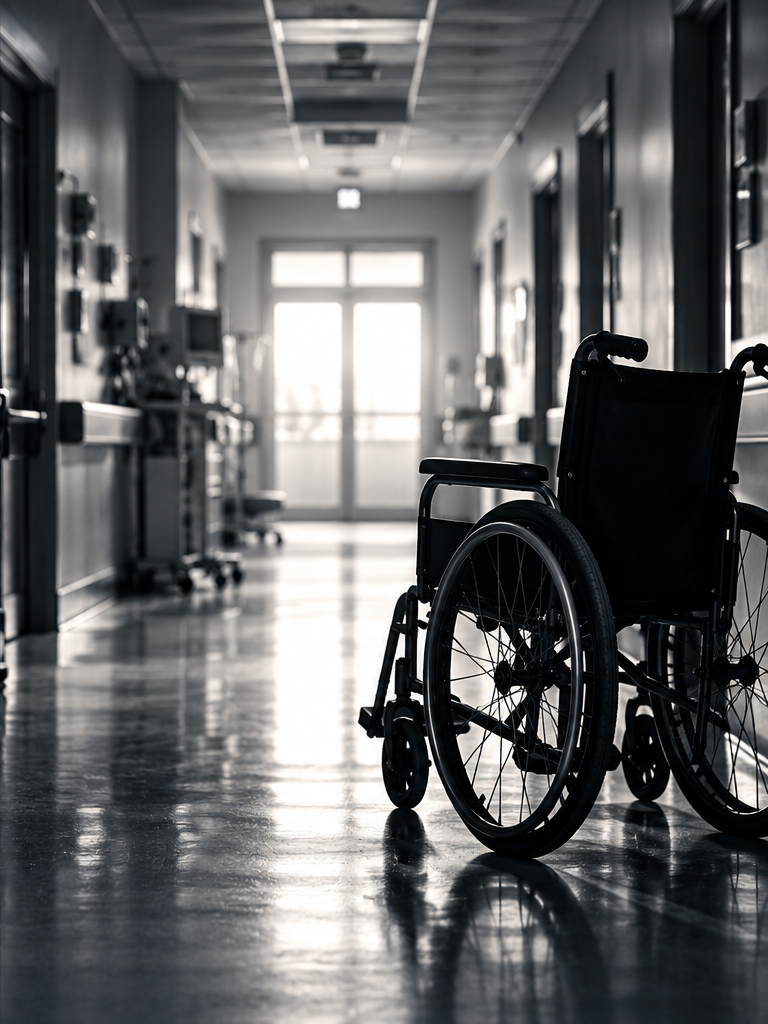
The Problem With Being Inspirational
I have spent the last several years learning more about disability than I ever intended.
Not from a textbook or a graduate program, but from the rather inconvenient experience of becoming quadriplegic.
Before my illness and surgeries, I was a teacher, a mother, a wife, and someone who loved being active.
I loved waking up early, walking my dogs, going to the gym, and watching the sunrise. I loved taking my children outside to ride their bikes. I loved writing by hand, researching subjects that interested me, and losing myself in something I was passionate about.
Then came neurological disease, repeated surgeries, life-threatening complications, a brain infection, a ventilator, and a long rehabilitation journey.
My life changed in ways I could never have anticipated.
For a long time, I didn’t particularly want to talk about it.
I was too busy trying to survive it.
And even after the immediate danger passed, I was still trying to understand what had happened to me physically, emotionally, and intellectually.
There is a peculiar kind of grief that comes with losing abilities you once took for granted.
Not just the obvious things, like walking or dressing yourself, but the little pieces of your identity that quietly disappear alongside them.
The freedom to leave the house without planning an expedition. The ability to pick up a pen and write when inspiration strikes. The spontaneous afternoon adventures with your children.
The ordinary things that make a life feel like your own.
And somewhere along the way, people begin calling you inspirational.
I understand the sentiment, and I appreciate the kindness behind it.
But sometimes survival isn’t an act of courage.
Sometimes it’s simply what happens when you wake up the next morning and discover you’re still here.
There are moments of extraordinary strength in disability, certainly.
There are also moments of frustration, grief, boredom, resentment, laughter, and the occasional desire to tell the entire world to mind its own business.
We are human beings, after all.
Not Hallmark cards with medical histories.
The Price of Being Seen
What interests me most about the rise of disability influencers isn’t necessarily the people creating the content.
It’s the audience.
What are we looking for when we watch?
Are we trying to understand the experiences of people whose lives are different from our own?
Or are we looking for a reassuring reminder that things could always be worse?
Do we admire resilience because we genuinely value it?
Or because celebrating an individual’s strength allows us to avoid examining the circumstances that made such strength necessary?
I suspect the answers are as varied as the people watching.
But there is a danger in turning disability into a spectacle.
When we only celebrate disabled people who accomplish extraordinary things, we risk implying that ordinary disabled lives are somehow less valuable.
When we reward stories of miraculous recovery, we can unintentionally suggest that people who don’t recover simply haven’t tried hard enough.
And when we make financial support dependent upon how convincingly someone can demonstrate their suffering, we create a system in which dignity becomes negotiable.
Show us your struggle.
Make it emotional.
Make it shareable.
Preferably keep it under sixty seconds.
And don’t forget to smile at the end.
The audience loves a happy ending.
Unfortunately, chronic illness and spinal cord injuries are notoriously bad at following a three-act narrative structure.
Some days you improve. Some days you regress. Some days you spend an entire afternoon trying to accomplish something you could do without thinking five years ago.
There isn’t always a breakthrough.
Sometimes there is just Tuesday.
And Tuesday deserves dignity, too.
Finding My Way Back Through Words
I never wanted my medical history to become the most interesting thing about me.
For a long time, I was reluctant to share much of it at all.
But recently, something has changed.
I’ve started researching and writing again.
Not because I want to turn my life into a social media production, but because writing and learning have always been part of who I am.
Before I became disabled, I loved teaching. I loved helping people understand complicated subjects, challenging assumptions, and discovering how much there was still to learn.
Losing so much of my physical independence made me feel disconnected from that part of myself.
And finding my way back to research, journalism, and advocacy has reminded me that my mind still has places to go, even when my body cannot follow.
That’s why I started Wheeling to Make a Difference.
I want to research neurological conditions and spinal cord injuries. I want to explore disability rights, accessibility, rehabilitation, and the policies that shape the lives of millions of Americans.
I want to write about businesses that make meaningful efforts to welcome disabled families, and question those that don’t.
I want to examine the systems that determine who receives care, who receives financial assistance, and who is left to figure it out alone.
And yes, I would love for my writing and research to eventually generate some income.
I don’t think there is anything shameful about that.
We compensate people for their knowledge, expertise, creativity, and work every day.
Why should someone who has acquired an unfortunate amount of firsthand experience navigating disability be expected to provide that knowledge for free?
There is an important difference between selling your suffering and being compensated for what you’ve learned from it.
I have no interest in making tragedy my personal brand.
But I do have an interest in making something meaningful out of a life that took a very unexpected turn.
And perhaps, if I’m lucky, earning a little money doing something that makes me feel like myself again.
What a radical concept: a disabled person wanting meaningful work, intellectual fulfillment, and financial independence.
Someone alert the authorities.
The World We Shape Shapes Us
The more I think about it, the more I realize that poverty porn and disability inspiration content are symptoms of something much larger.
They reflect the stories we choose to reward.
The people we choose to notice.
The suffering we find compelling.
And the suffering we’ve learned to ignore.
We have created a culture that can make a viral celebrity out of someone navigating a disability while simultaneously making it extraordinarily difficult for that same person to access transportation, rehabilitation, employment, or adequate caregiving.
We can raise thousands of dollars for a stranger’s medical expenses in a matter of hours, then spend years arguing about whether healthcare should be considered a right, a privilege, or a particularly expensive character-building exercise.
We can celebrate someone’s determination to overcome barriers while remaining remarkably uninterested in removing the barriers themselves.
And perhaps most ironically, we can spend an entire afternoon consuming stories about human suffering without ever meaningfully engaging with the people experiencing it.
The world we shape shapes us.
Every story we share, every headline we reward, every policy we support, and every injustice we excuse contributes to the kind of society we eventually inherit.
If we continually reward spectacle over substance, we shouldn’t be surprised when suffering becomes entertainment.
If we value inspirational stories more than meaningful solutions, we shouldn’t be surprised when the same problems persist.
And if we treat disabled people as objects of pity or admiration rather than equal participants in society, we shouldn’t be surprised when accessibility remains an afterthought.
I don’t think the answer is to stop telling difficult stories.
Quite the opposite.
I think we need more stories, better questions, and considerably more curiosity about what happens after the cameras stop rolling.
I want to hear about the wheelchair user who built a business, not just the one who learned to walk.
I want to hear about the mother who found a way to keep parenting after a catastrophic injury, not just the emotional moment her children saw her stand.
I want to hear about the researcher, the teacher, the artist, the writer, and the advocate whose disability is part of their experience without being the entirety of their identity.
And I want to hear about the policies, communities, and ordinary people making those lives more accessible.
Not because those stories are necessarily more uplifting.
But because they’re more complete.
I have no desire to become anyone’s daily dose of inspiration.
I would much rather make someone curious.
Curious enough to ask a question, reconsider an assumption, read a little further, or recognize a problem they hadn’t noticed before.
And if my research and writing eventually help support my family while allowing me to reclaim a piece of the person I was before all of this, I’ll consider that a pretty meaningful accomplishment.
After all, I’ve already contributed more than enough to the medical industry’s bottom line.
It might be nice to finally see a return on my investment.
I don’t want to make a living from being disabled. I want the opportunity to make a living while being disabled.
There is a difference.
And perhaps the world will become a little better when we finally learn to recognize it.
— Wheeling to Make a Difference


Leave a Reply