Roads, accessibility, and the apparently radical desire to know where our money goes.
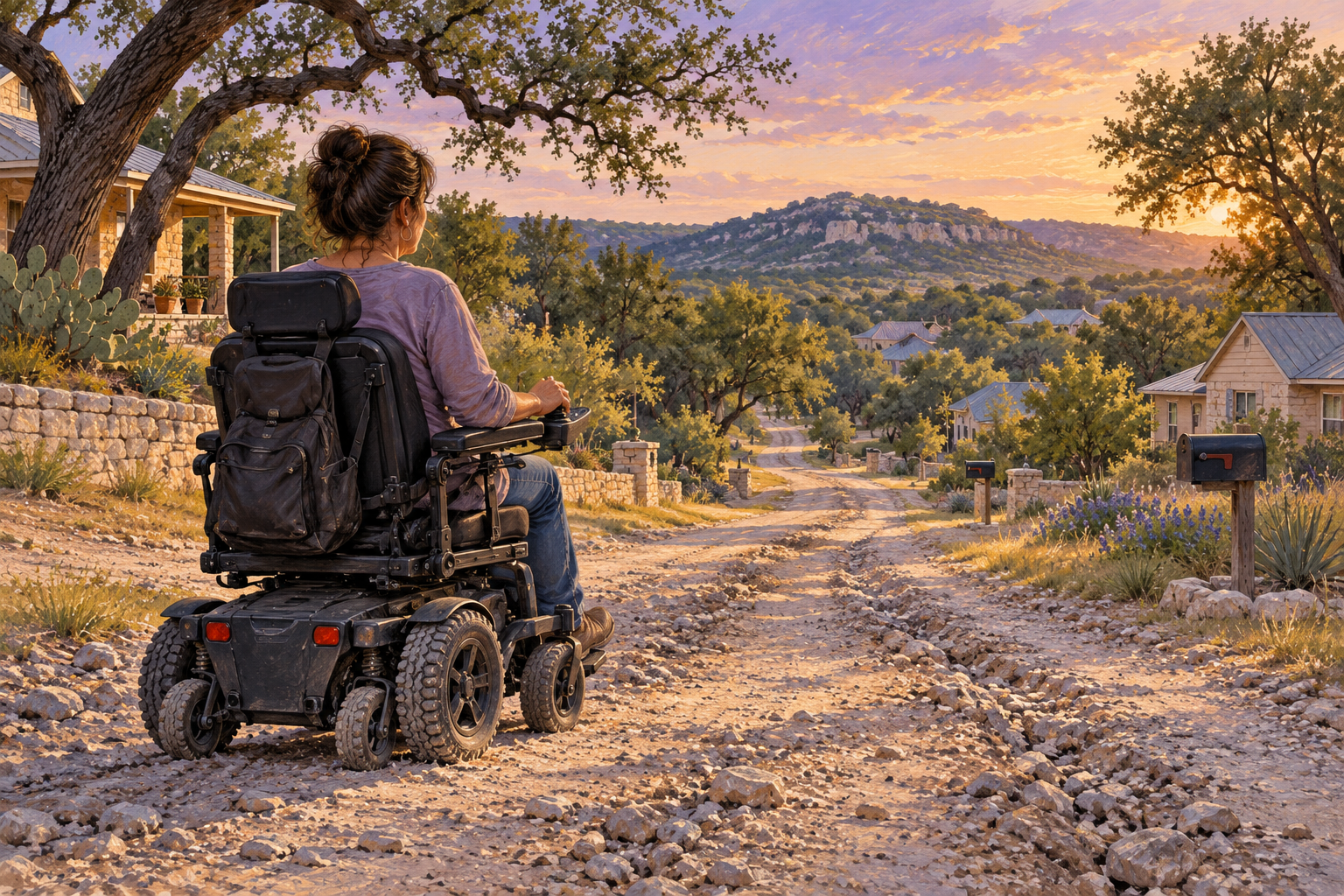
In Texas, property taxes can start an argument before anyone has finished their coffee. Here is my contribution: if local governments expect residents to pay for public services, residents should be able to get a clear answer about access to them. Apparently, my radical political platform is infrastructure and receipts.
I submitted my accessibility concerns through the road project’s advertised email address, before its public-comment deadline. I received an acknowledgment. I am still waiting for a substantive answer. On July 30, 2026, I emailed the listed project contact about how road conditions affect my safety and independence as a full-time wheelchair user. The deadline was August 7. The engineer replied that he would forward my concerns to Travis County and that the county would issue an official response to project comments. I have since followed up; as of October 21, I have not received that answer.
The Cardinal Hills project materials describe improvements to approximately 200 linear feet of Sutton Drive, rather than the whole road. They also explain that the project roads are not currently county-maintained and are being improved toward acceptance for county maintenance. That distinction matters. So does explaining why the project boundaries fall where they do, how disability access affected those decisions, and what happens to residents beyond those boundaries. Before we retreat into another argument about whether property taxes are too high or government needs more money, can we get those answers? I realize this makes me a painfully boring moderate. Somewhere, a social media algorithm has already lost interest.
But when you use a wheelchair, the condition of the road outside your house becomes considerably more interesting. Suddenly, gravel is a subject you have opinions about. Drainage enters your vocabulary. You find yourself wanting to know who sits on a commissioners court.
Nobody prepares you for this part of adulthood. Or disability.
Before I became quadriplegic, I used to walk my dogs, go to the gym, and watch the sunrise. In the afternoons, I took my children out to ride their bikes. Getting outside was an ordinary part of my life, something I could decide to do without turning it into a logistical exercise.
Then came repeated surgeries for Chiari malformation—a condition involving crowding where the brain meets the spinal cord—and syringomyelia, a fluid-filled cavity within the spinal cord. My medical journey included a severe spinal-fluid leak, a brain abscess, a ventilator, and complications I am still learning how to put into words.
There were moments when my family did not know whether I would survive.
I did. Recovery has involved nearly nine months in inpatient rehabilitation, followed by more than a year of physical and occupational therapy at home. Progress has come with setbacks, uncertainty, and an extraordinary amount of work.
After all that, I would really like to go outside.
That sounds almost absurdly small beside everything it took to get here. But the small things are often what you are working toward: being with your children, getting some fresh air, participating in the neighborhood beyond your front door.
An uneven dirt road can stand between you and those things.
From a car, a rut may be an unpleasant bump. From a wheelchair, it can change whether a route feels manageable or safe. Loose ground and deep grooves turn an ordinary outing into a series of decisions about risk, assistance, and whether the effort is worth it.
There is a particular frustration in working so hard to regain independence and discovering how much of it depends on the ground beneath you.
Neighbors on our stretch of the street have worked together for decades to maintain the road as best they can.
And that is where my interest in property taxes becomes more than the usual complaint about a bill.
Texas has no state property tax. Local governments collect property taxes to support services that include schools, roads, and public safety. Multiple taxing units can appear on the same household’s bill, each with its own responsibilities and budget. The appraisal district determines property values; the governing bodies of those local taxing units set their tax rates. Source: Texas Comptroller.
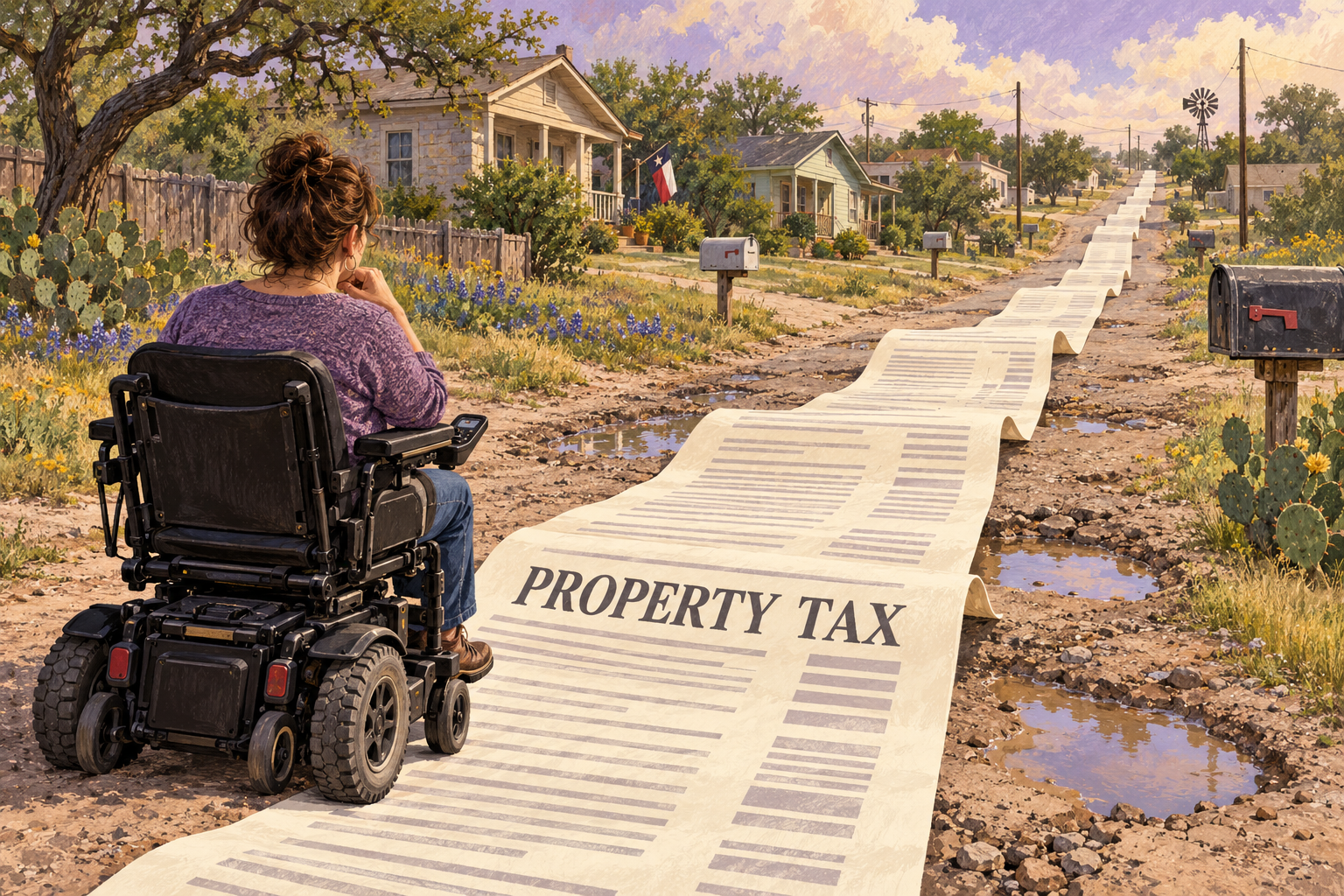
In Travis County, the bill is a collection of separate local taxes. The county sets its own portion; it does not set every rate on the statement. Think of it as several governments sharing an envelope. Unfortunately, the envelope does not come with a helpful diagram. So I made one.
First, TCAD determines property values and administers exemptions. Applicable appraisal limits and qualifying exemptions affect the value used for taxation. Because exemptions can differ by taxing authority, one property can have several taxable values. TCAD does not set tax rates. Source: TCAD’s property-tax system guide. Exemption information.
Each applicable local governing body adopts its own rate. Depending on the property’s location, those bodies can include the county commissioners court, a school board, a city council, and special-district boards. The tax office uses the taxable values and adopted rates to calculate the charges. Source: Travis County tax-rate information.
The basic calculation for each authority is: taxable value ÷ 100 × tax rate = annual tax. For a hypothetical $400,000 taxable value and a rate of $0.40 per $100, that authority’s charge would be $1,600. That is one line on the bill, not the total. Other applicable charges are calculated separately and added, subject to any applicable tax ceilings. The county’s estimator accounts for exemptions and qualifying ceilings.
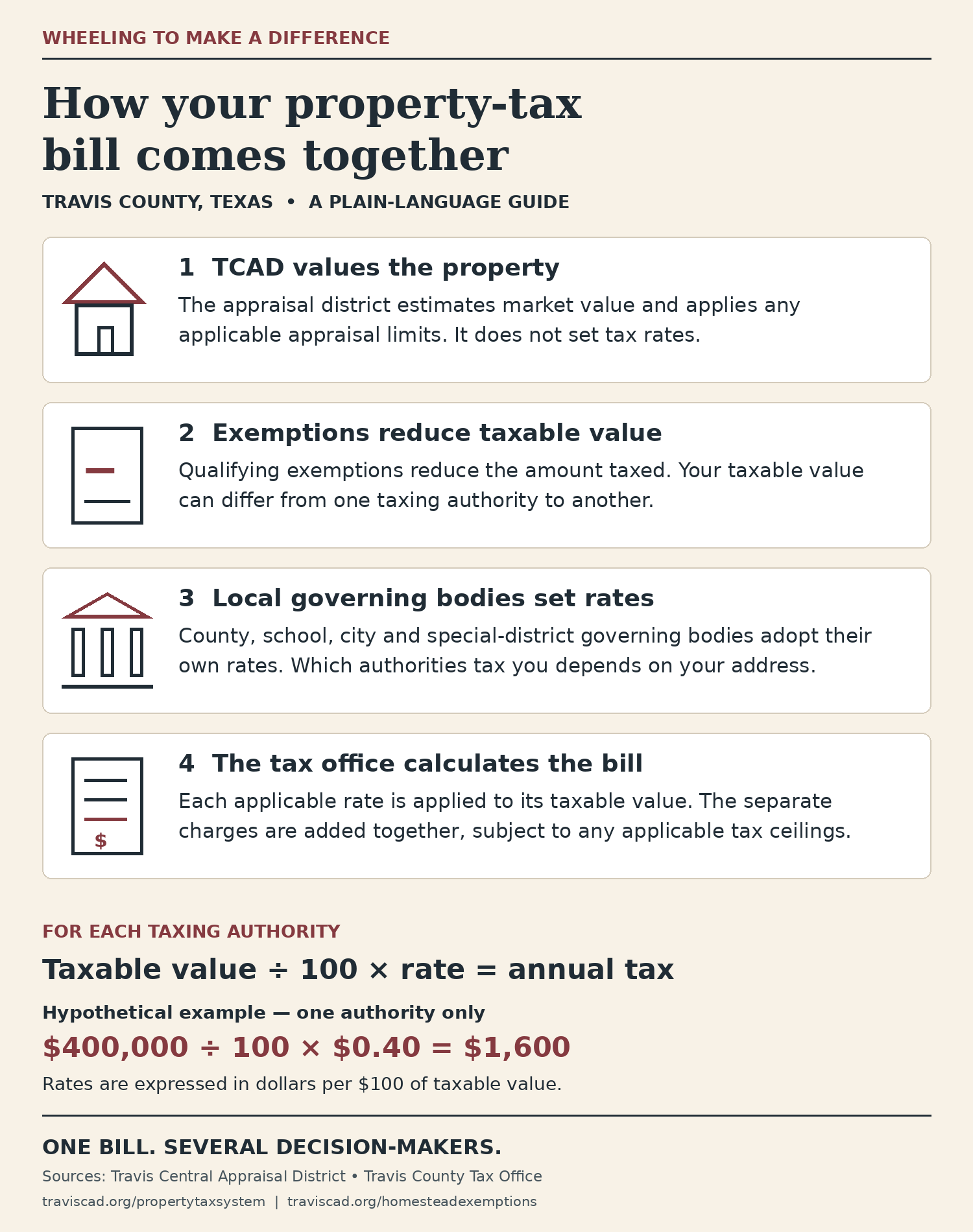
This is why stronger oversight cannot stop at property appraisals. Reviewing valuations addresses one part of the system. The governing bodies approving tax rates, budgets, and road priorities also need to explain their decisions—and their combined effect on residents. A clearer appraisal process alone will not tell me why an accessibility concern remains unanswered. Residents can look up the taxing authorities and rates associated with their property through Travis Taxes.
I understand that paying property taxes does not purchase a personal paving crew. Road ownership and maintenance responsibility matter, too; counties generally face restrictions on maintaining private roads, with specific exceptions. Source: Texas Association of Counties.
But understanding that the system is complicated does not mean residents should have to accept that it is impossible to follow.
Who is responsible? What money is available? How are projects ranked? Where does accessibility enter the calculation? If improvements cannot happen now, what steps would make them possible?
Those seem like reasonable questions.
Admittedly, “reasonable questions” is a terrible campaign slogan. Difficult to chant. Very little merchandising potential.
The numbers are substantial. TxDOT reported approximately $5.92 billion in fiscal year 2025 expenditures across three maintenance categories: maintenance contracts, contracted routine maintenance, and routine maintenance. Its FY2026 budget lists about $6.53 billion across those same categories. Those totals are the sum of the three budget lines, excluding ferry operations. Source: TxDOT FY2026 Operating Budget, printed page 5.
Those are state agency figures, not a total for every city and county road in Texas. TxDOT’s funding includes fuel taxes, registration fees, federal reimbursements, and other sources; it would be misleading to describe that money as local property-tax revenue or assume it is available for our street. Source: TxDOT FY2025 Popular Annual Financial Report.
The accessibility picture is harder to reduce to a single annual number. TxDOT describes approximately $1.6 billion in identified accessibility barriers tracked through its accessibility management system. That is an estimate of identified needs, not a yearly spending total. I could not verify one consolidated statewide annual figure covering accessibility improvements across roads, public buildings, parks, and transit. Source: TxDOT Civil Rights Division.
That is precisely the kind of information I would like stronger oversight to make easier to find.
Imagine one clear statement showing the combined impact of proposed local taxes. Each government could explain its own request, but residents would also see what all those requests mean together for their household. Our budgets experience the total, regardless of how many separate meetings produced it.
Imagine independent spending reviews with findings people can actually read. Those reviews could examine administrative duplication, contracting costs, and whether funded projects accomplish what was promised. When problems emerge, the responsible government would have to publish a response and a plan.
Imagine requests for additional revenue accompanied by specific commitments. What would the money fund? What alternatives were considered? What would residents lose without it? When could we expect results?
Imagine road-priority lists that account for how a neighborhood is changing. How many people are moving onto a road? How many households depend on it now compared with five years ago? Are deliveries, construction vehicles, and everyday traffic increasing? Those changes should factor into decisions about maintenance, drainage, and improvements.
A road that once served a handful of homes may now carry considerably more traffic. Infrastructure planning should keep pace with that growth—and explain how additional tax revenue from new development fits into the funding picture.
Population and traffic should sit alongside emergency access, road conditions, and disability access in the equation. A busy road deserves attention, and a quieter road can still present an urgent barrier to the people living on it.
If a neighborhood is growing, “that’s always been a dirt road” starts to sound less like a plan and more like a family tradition nobody remembers agreeing to.
Imagine an annual accessibility report that follows the money through to results. Residents could see what each responsible agency spent, which barriers were removed, what remains, and when the next improvements are expected.
Imagine being able to participate without making public comment a second job. Accessible documents, plain-language summaries, and practical ways to submit questions would give more residents a chance to be heard—including people whose health makes attending an evening meeting difficult.
These are hypothetical reforms, not a claim that Texas has no existing safeguards. The state already requires tax disclosures and provides voter-approval mechanisms for certain increases. The question is how to make accountability more useful to the people living with the results. Source: Texas Comptroller.
An oversight process would need accountability of its own: transparent appointments, conflict-of-interest rules, public findings, and clear limits on its authority. Otherwise, we could end up paying for another board whose primary achievement is scheduling another meeting.
I am willing to accept a certain amount of bureaucracy. I would simply prefer that it occasionally produce a road.
And I want the conversation to leave room for an honest answer. Sometimes a project needs more funding. Sometimes priorities need to change. Sometimes legal barriers require a different approach. Good oversight should help us distinguish those situations instead of reducing every question to whether someone loves taxes or hates government.
Getting outside also has implications beyond having something pleasant to do.
A 2019 study of 19,806 adults in England found that spending at least 120 minutes a week in nature was associated with better self-reported health and wellbeing. Those hours could come from one longer visit or several shorter ones. This was an association, not proof that outdoor time caused the difference or a prescription requiring everyone to go outside daily. Read the study.
The research did not require a mountain summit, an impressive fitness tracker, or a personality built around hiking.
Meanwhile, a CDC analysis of 2018 data found that 32.9% of adults with disabilities reported frequent mental distress, compared with 7.2% of adults without disabilities—about 4.6 times as often. “Frequent” meant at least 14 mentally unhealthy days in the previous 30 days. Source: CDC.
A separate 2015 meta-analysis of 19 studies involving 35,676 people estimated the prevalence of diagnosed depression after spinal cord injury at 22.2%. These are different populations: neither figure represents all wheelchair users, and neither proves that inaccessible roads cause depression. They do give us reason to take wellbeing seriously when discussing recovery and community support. Read the spinal cord injury review.
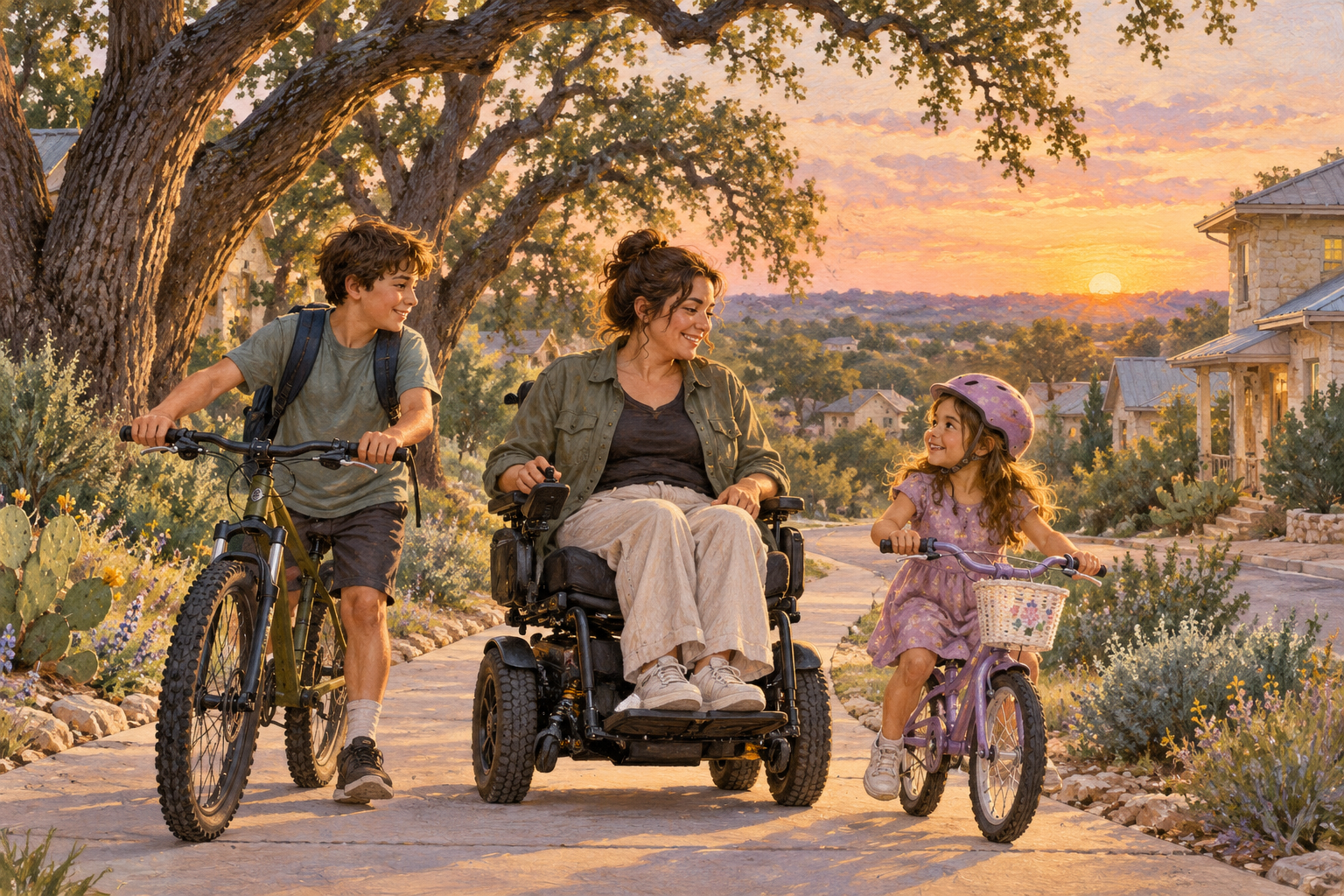
For me, getting outside means having somewhere to go beyond the spaces where I receive care. It means spending time with my children and enjoying a part of the day that does not revolve around what my body needs help doing.
I am already working with ARCIL, and they have been a godsend. A custom manual wheelchair with power assist is in the works, and I am hopeful about a new power wheelchair, an outdoor powered lift, and an automatic door opener as well.
These things could give me more freedom in the ordinary moments of my day: getting through a doorway, getting outside, deciding to do something without needing quite so much help.
That is what meaningful support looks like. People listening to what would make your life more manageable and helping you work toward it.
For readers facing similar barriers, ARCIL’s Independent Living Services program lists wheelchairs, van modifications, and home barrier removal among its services. It works with insurance and other resources, with participant cost-sharing based on income and expenses. Travis County is within its service area; the Austin office can be reached at 512-832-6349.
Other resources include the Lone Star Paralysis Foundation, which offers therapy scholarships and adapted sports and outdoor recreation opportunities, and the Texas Ramp Project, which provides free ramps for qualifying people through referrals from healthcare or social-service professionals. Eligibility, funding, and availability vary.
Texas also supports Independent Living Services through local providers such as ARCIL. Eligible STAR+PLUS Home and Community Based Services members can ask their service coordinator about adaptive aids, including certain lifts and vehicle modifications approved in their service plan.
These programs matter. So does the infrastructure connecting our homes to the life they help us reclaim.
We can help someone obtain a wheelchair and still leave them facing a route they cannot safely use. I would like our definition of mobility to extend a little farther than the delivery of the mobility device.
My medical experience has changed what I notice. I notice entrances, surfaces, distances, and the effort hidden inside an activity other people can do without thinking.
I also notice how easily a practical need can disappear into a process.
For the person waiting, that delay is measured in more than budget cycles. It is another afternoon inside. Another outing requiring help. Another ordinary moment with your children that becomes harder than it needs to be.
I want public decisions to account for that.
So yes, my politics on this particular issue are embarrassingly moderate. I would like taxes to be justified, spending to be traceable, and accessibility to matter when priorities are set.
I would also like to take my wheelchair down the road without feeling as though I have accidentally entered an off-road sporting event.
Put that on a campaign sign, if you must.
Just make sure there is a firm, reasonably level surface leading up to it.


Leave a Reply