My insurance broker saga—and why getting help should not require passing a dexterity test.

There is a particular kind of exhaustion that comes from calling a help line and realizing your first job is going to be helping the help line understand what help you need.
You prepare your explanation. You gather your information. You navigate the menu. You wait. By the time a human answers, you have already completed a small unpaid internship in administrative persistence.
Then the actual work begins.
During a recent call about my health insurance, I was trying to sort out confusion involving my broker and another person whose name I did not recognize.
The representative asked whether I knew my original broker.
“Yeah,” I said. “That’s my original broker.”
Then came a question about the other person.
“Yeah, I don’t know him.”
That seems like a fairly important distinction: the person I chose to help with my insurance versus someone I did not recognize. Yet establishing that distinction was only one step in figuring out what had happened and what, exactly, would happen next.
The representative told me the other person had tried to update my application but had not completed it. She offered to finish updating it.
My question was immediate:
“Will it change my broker back?”
Because updating my application and restoring the person I chose to help me did not necessarily mean the same thing. I needed to know whether the proposed solution addressed the reason I was calling.
A little later, I tried again:
“I need Peter back as my person.”
I know who I chose. I want that person helping me. Please tell me how we get back there.
There should be a clear path from that request to an answer.
Instead, the next words were:
“Okay, just bear me one moment.”
Of course.
If patience earned insurance credits, I would like to submit my balance.
When help comes with an entrance exam
I am quadriplegic. That changes the practical demands of a phone call in ways a customer-service script may never acknowledge.
“Press one for English” assumes I can press one.
I understand the language. The button is where our relationship falls apart.
A callback assumes I can answer within the allotted rings.
A direction to open something, locate something, enter something, and return to the call assumes those are quick, uncomplicated actions.
For me, they may require assistive technology, additional time, or another person’s help.
These are the mechanics of reaching the service. They come before I have even had the opportunity to explain the problem.
And when a callback ends before I can answer, I worry about what the system records: unreachable, failed to respond, try again later.
What I want it to understand is simpler: I was trying to get to the phone.
A system should not turn the speed of someone’s hands into a measure of their willingness to participate.
Millions of people live outside the script
The assumption that everyone can “just press one” deserves a little scrutiny.
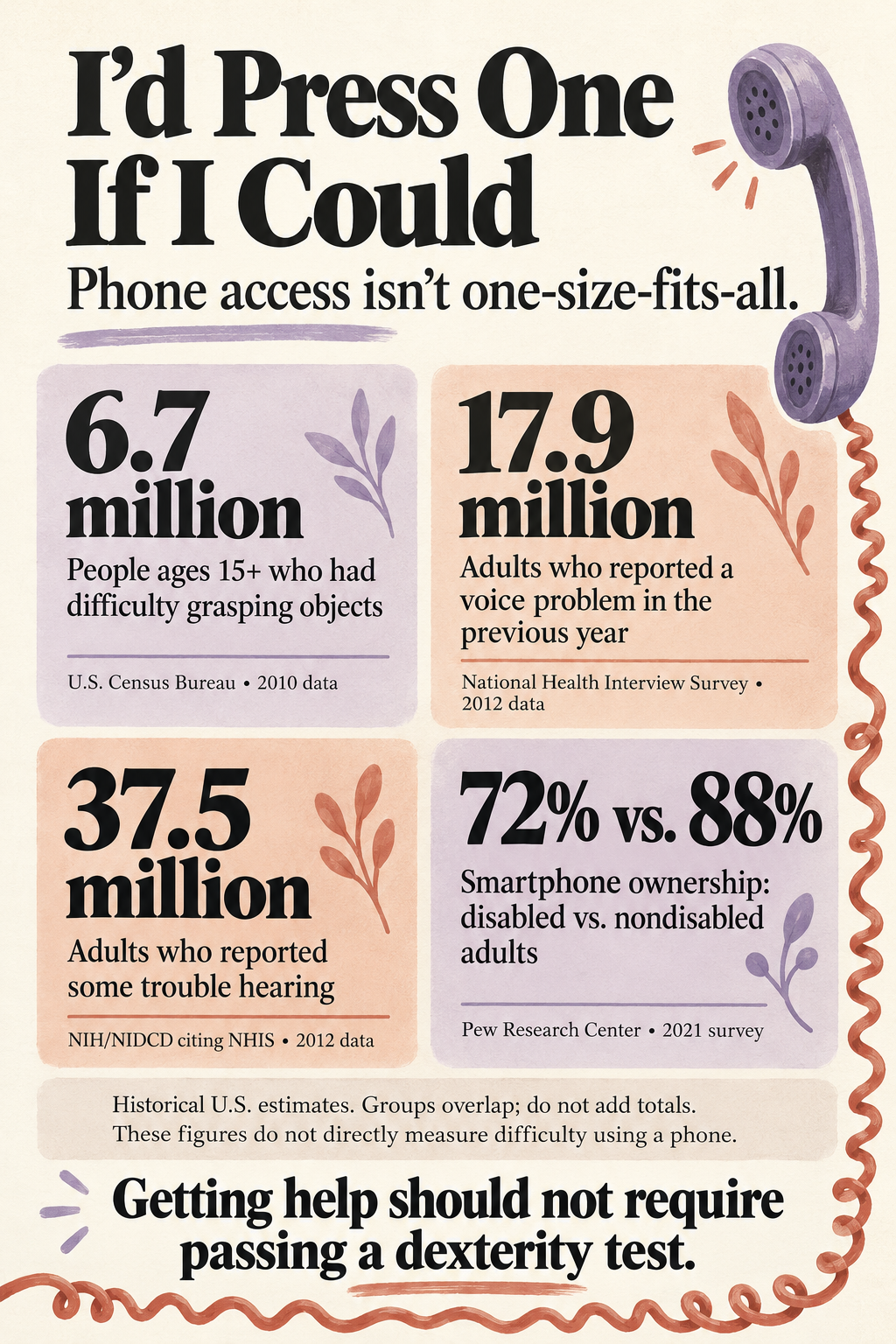
Census Bureau data from 2010 estimated that 6.7 million Americans ages 15 and older had difficulty grasping objects such as a glass or pencil. About 893,000 were unable to do so. Source: Americans With Disabilities: 2010.
A separate analysis of the 2012 National Health Interview Survey estimated that 17.9 million adults—7.6 percent—had experienced a voice problem during the previous year. That includes temporary problems as well as longer-lasting difficulties. NIH also cites an estimate from 2012 that 37.5 million adults reported some trouble hearing. Voice study; NIH hearing statistics.
These are historical estimates, not current counts of people unable to use a telephone. The groups overlap, and the surveys did not directly measure difficulty navigating phone menus. What they demonstrate is that millions of people experience difficulties involving the very functions these systems take for granted.
“Press one or say your answer” may sound like offering everyone a choice. For someone who struggles with both, it is two locked doors and an automated voice congratulating itself on customer service.
And “just use the website” does not solve everything, either.
In a 2021 Pew Research Center survey, 72 percent of disabled adults reported owning a smartphone, compared with 88 percent of nondisabled adults. Fifteen percent of disabled adults said they never went online, compared with 5 percent of nondisabled adults. Owning a device, of course, also does not guarantee that every website, app, or verification process will be usable. Source: Pew Research Center.
Then there is the detail that practically writes its own punchline: Pew acknowledged that its telephone survey likely underrepresented people who were deaf or had difficulty speaking.
The people who struggle to get through on the phone can also struggle to get counted in the research.
Your experience matters to us. Please answer this telephone to prove it.
A kind representative still needs a better system
In the exchange, the representative thanked me for bearing with her. I appreciate that. The point is not to make a villain out of someone working through a complicated process.
The point is that courtesy cannot carry the entire weight of accessibility.
A person can be patient and well-intentioned while the process still leaves the caller confused about who has access to their application, what changes are being proposed, and whether the original concern is being resolved.
The transcript excerpt does not establish why the unfamiliar person was involved or whether any unauthorized change occurred. It does show why a clear explanation matters.
Before asking someone to proceed, a help system should make the next step understandable.
Here is what we found.
Here is what remains uncertain.
Here is what this action will change.
Here is whether it resolves your broker concern.
Wouldn’t that be a refreshing little plot twist?
When the subject is your health insurance, you should be able to understand what you are agreeing to without simultaneously serving as the call’s project manager.
Ask the people who actually use it
Designing a help system without involving the people who depend on it is a little like designing a wheelchair-accessible bathroom without ever asking a wheelchair user to try it.
The grab bars are there. The sign is on the door. Everyone congratulates themselves—until someone discovers they cannot close the door behind their chair.
Help systems can have the same blind spot. Everything looks straightforward to the person who can press the buttons, answer quickly, and jot down the confirmation number.
The good news? The people who can help improve these systems are already calling. We are explaining where we get stuck, what would help, and why it matters.
Start by asking how the person can communicate and what they need to complete the interaction. Give callers a way past a keypad-only menu. Offer accessible written communication, more time to respond, and callback arrangements that account for physical limitations.
Let people record their communication preferences so they do not have to renegotiate the same accommodation every time they need help.
When a concern involves an unfamiliar broker, explain who is listed, what activity can be confirmed, and how the customer can verify or restore their chosen representative. Distinguish an attempted update from a completed change.
Keep notes that travel with the issue so the next person does not require the caller to perform the entire story from the beginning.
And finish with a plain-language summary: what changed, what did not, what is still pending, and who is responsible for the next step.
These are practical design choices. They would also help anyone who is overwhelmed, ill, exhausted, or simply unfamiliar with insurance vocabulary—which seems like a substantial portion of the intended audience.
I do not expect every representative to know everything immediately. I do expect the process to make room for the person asking for help.
There is a better way to answer the call

Bring disabled people into the design process. Hire us. Pay us for our expertise. Let us test the systems before somebody declares them accessible and orders a commemorative plaque.
That could create jobs while making services better for the people who use them. It would also send a message that reaches well beyond a paycheck: your experience matters, your ideas belong here, and your community wants you involved.
There is something deeply hopeful about a society that makes room for you before you have to spend three hours on the phone requesting it.
And we need able-bodied partners willing to help make that happen. Ask whether the services at your workplace are accessible. Speak up when someone’s request for more time gets treated as an inconvenience. Support disabled people in positions where we can actually make decisions.
Please do not make the person struggling to press one also be solely responsible for restructuring the entire customer-service department. My afternoon is already booked.
Use your voice. Use your vote. Look for leaders whose policies and actions show a commitment to doing the most good for the people around them—including people whose needs look different from their own. Ask what they are doing to make health care, employment, and public services easier to access, and follow up after the campaign signs come down.
We can build a community where asking for help feels ordinary, where more people have opportunities to contribute, and where being cared for shows up in the practical details of everyday life.
We have more to contribute than a customer satisfaction score.
And, as it happens, we have had plenty of time on hold to think of improvements.


Leave a Reply