
On medical trauma, tort reform, and being expected to explain the worst days of your life before you have even begun to understand them.

Editorial illustrations are AI-generated interpretations, not photographs of my hospital stay.
Even today, I am having trouble talking enough to get this written.
You cannot hear that when you read a finished article. You cannot hear the effort behind the sentences or know which memories require me to stop. You see the words after I have managed to get them out.
Texas generally gives patients two years to file a medical malpractice lawsuit, subject to legal rules and exceptions that can affect the deadline. It has taken me about that long to even be able to talk about what happened. [1]
That is the part I want people to sit with.
Before the intake forms. Before the medical records. Before the conversation about whether there is a case worth pursuing.
What happens when the time it takes to find your voice is also the time in which you are expected to use it?
I am talking about surgeries, complications, a brain abscess, a ventilator. About coming close enough to death that my family was called to say goodbye. About surviving and then having to figure out how to live in a body that no longer worked the way it had before.
And about a hospice memory box being prepared for my children.
A box to help them remember their mother.
While I was still here.

I ended up on a ventilator in a state I still struggle to describe. The closest I can come is an LSD-like experience: distorted, frightening, and difficult to separate into a clear sequence of events. That is how it felt to me.
I felt trapped inside a body that could not communicate what was happening within it. Like being awake in a coma. I had thoughts. I had fear. I needed people. But I could not simply open my mouth and tell them.
It was one of the worst feelings I have ever experienced.
People would run their fingers along the alphabet, and I would nod when they reached the letter I wanted.
Then we would start again.
Think about how much you might need to say in a hospital bed. Something hurts. You are scared. You want someone to stay. You have a question about what is happening to you.
Now imagine having to assemble each thought one letter at a time, relying on another person to notice your nod.
I remember asking my cousin to sing.
I remember asking one of my good friends to visit often because she understood what I was trying to say. The relief of being understood is difficult to explain until you have experienced the terror of being unable to make yourself understood.
I remember another friend who would really stand up for me.
Someone singing. Someone understanding. Someone speaking up.
Those are among the things I can still reach clearly. Other parts have been told to me afterward.
I have been told that they were preparing to withdraw the support keeping me alive. That someone was explaining what would happen to my body. That I began shaking my head, trying to say no.
I do not remember the entire conversation.
I remember no, no, no.
Months earlier, I had signed a do-not-resuscitate order. I had been deeply depressed and exhausted by fighting this disease. I had reached a place where I felt almost done.
I never really imagined that decision becoming an immediate reality.
Somewhere inside, I also believed my family would fight for me if that moment came. My understanding is that they were trying to respect what they believed I wanted.
A DNR and a decision to withdraw ventilation are different things, and I cannot reconstruct every medical decision from my fragmented memories. What I am describing is the distance between the despair I had felt months earlier and what I remember wanting in that moment.
I wanted to stay.
Now imagine trying to make sense of that after surviving.
Your earlier wishes. Your family’s understanding of them. The terror you remember. The conversations you cannot remember. The people who loved you trying to navigate something unbearable themselves.
Your children.
That box.
There is love and fear tangled together in those memories. There are questions I am still finding language for. I cannot make it all neat simply because I survived.
These are deeply private experiences. Even putting them into a sentence can feel like exposing something I am still trying to protect.
And then you have to call a lawyer.
You have to find a starting point in a story that, for you, has never really ended. You have to explain what happened, when it happened, what you believe went wrong, and how your life changed. You have to distinguish what you remember from what you were later told.
You have to turn a terrifying, disorienting stretch of your life into something another person can evaluate.
Preferably concisely.
Apparently, nearly dying also requires an elevator pitch.
I understand that attorneys need facts. They need dates, records, and evidence. A devastating medical outcome does not, by itself, establish negligence. No attorney can take every case.
But understanding those realities does not make the experience of telling your story any less painful.
You open something you have barely learned how to touch. You explain the most vulnerable moments of your life to a stranger. You hope you have said enough, in the right order, with enough clarity to be understood.
Then comes the rejection, the brief response, or the silence.
And if you want to keep looking for help, you do it again.
There is no guarantee that the next conversation will build on the last one. You may have to begin at the beginning, with another person who has never heard your name and has no idea what it took for you to make that call.
For the office, it is an intake.
For you, it can be the rest of the day.
Research helps explain why finding representation can be so difficult.
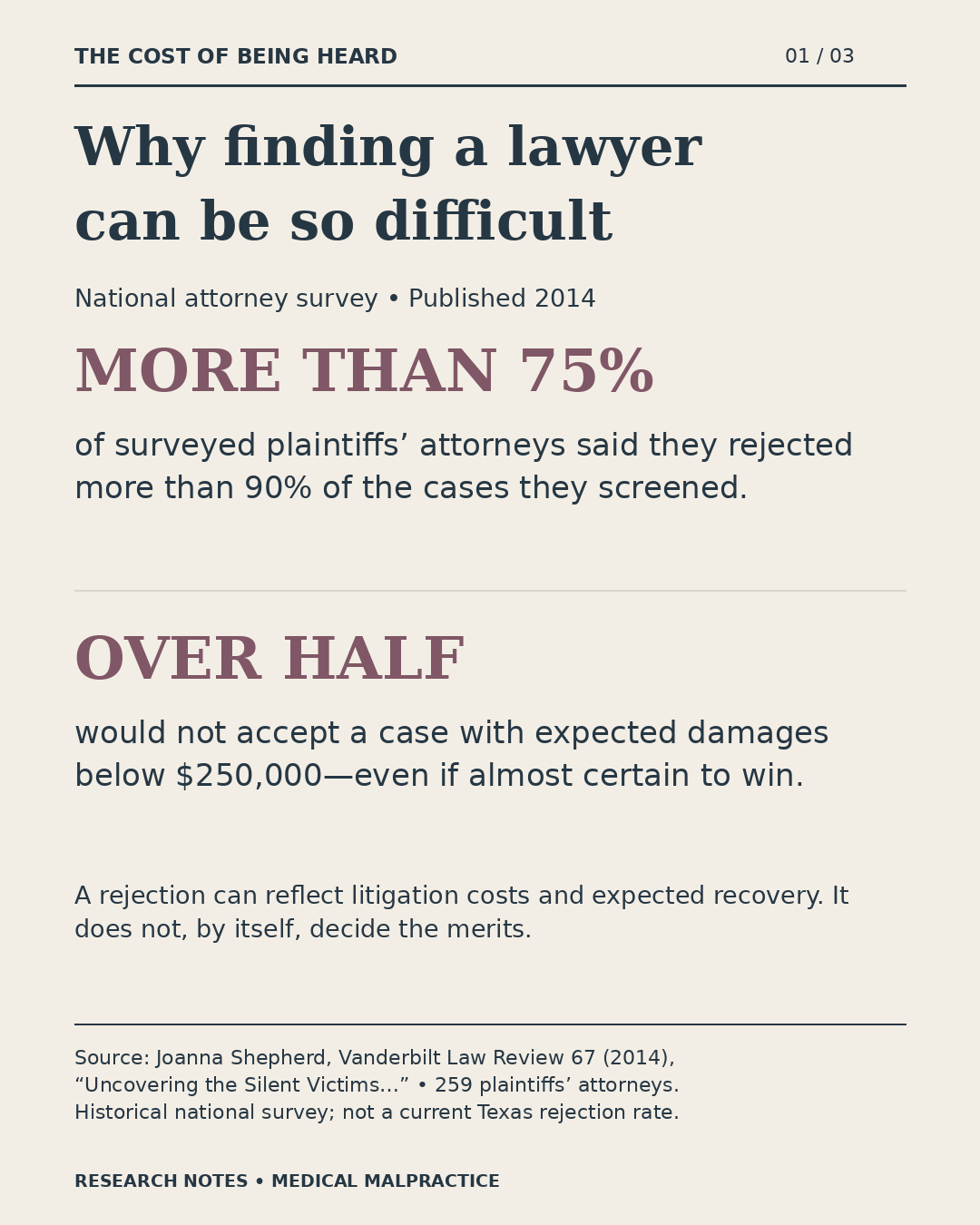
In a national survey published in the Vanderbilt Law Review in 2014, more than three-quarters of surveyed plaintiffs’ attorneys reported rejecting over 90 percent of the cases they screened. More than half would not accept a case with expected damages below $250,000—even one they were almost certain to win. The analysis covered 259 plaintiffs’ attorneys. [2]
These are historical national findings, not a current Texas rejection rate. They do not establish that every rejected case was valid. They do show how litigation expenses and expected recovery can determine whether someone gets representation.
A decision not to take a case is not a verdict on whether someone suffered, or even a definitive finding about whether their care was appropriate. But when you have just handed over the most painful parts of your life, it can be difficult to keep those distinctions emotionally separate.
It can feel like being told that what happened was not enough.
Or that you explained it badly.
Or that you should have found the strength to explain it sooner.
This is where the conversation about tort reform becomes personal for me.
“Tort reform” sounds administrative. It sounds like something discussed in a conference room by people who can leave when the meeting ends.
In Texas, the medical liability framework includes limits on noneconomic damages—the category that includes losses such as pain and suffering—as well as a generally two-year filing deadline. Those are distinct legal restrictions, but patients encounter them as parts of the same system. [1] [3]
The frequently cited $250,000 cap is not a blanket maximum for an entire malpractice case. It generally applies to noneconomic damages against physicians and noninstitutional providers collectively, with separate institutional limits potentially bringing the combined ceiling to $750,000 when multiple liable institutions are involved. Economic damages, such as medical expenses and lost earnings, are separate from these particular caps. [3]
But “noneconomic” is a remarkably bloodless word for the parts of an injury that do not arrive with an invoice.
The terror of being unable to speak. The suffering that follows you home. The emotional consequences of knowing your children nearly lost you.
The legal categories may be necessary. They are also very far from the way a person experiences what happened.
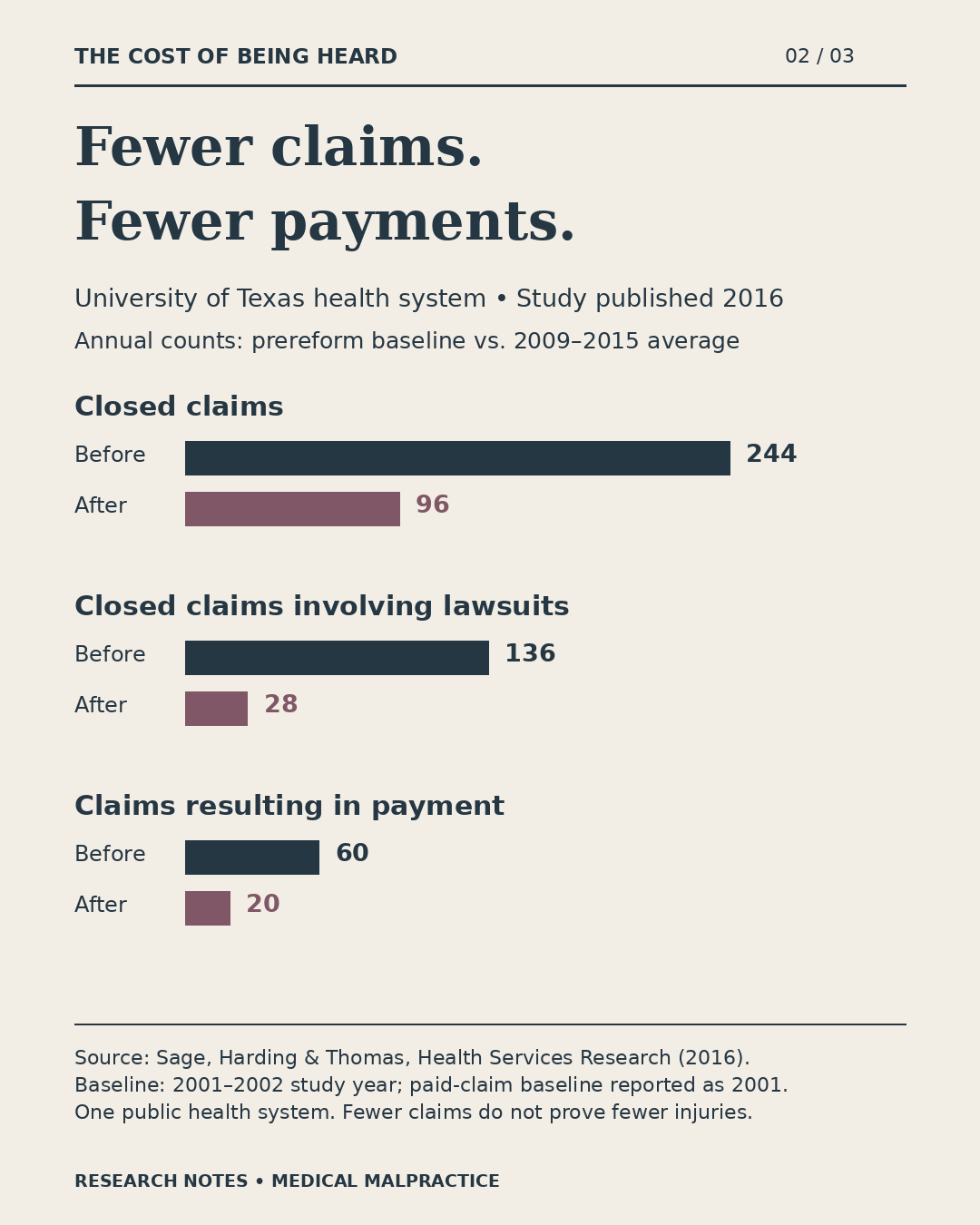
A 2016 study of the University of Texas health system found that paid claims fell from 60 in its prereform baseline to an annual average of 20 in 2009–2015—a decline of about two-thirds. Closed claims involving lawsuits fell from 136 to an annual average of 28. This was one large public academic health system, not the entire state. [4]
Those numbers tell us that fewer claims resulted in payment and fewer closed claims involved lawsuits. They do not, by themselves, tell us that fewer patients were injured.
That distinction matters when reduced litigation is presented as proof that a system is working.
Working for whom, and measured how?
I can understand the argument for making malpractice insurance more affordable. Doctors need to be able to practice. Communities need hospitals and specialists. The financial pressures of providing care deserve serious attention.
But so does the question of what patients received in exchange for restrictions on their ability to seek compensation.
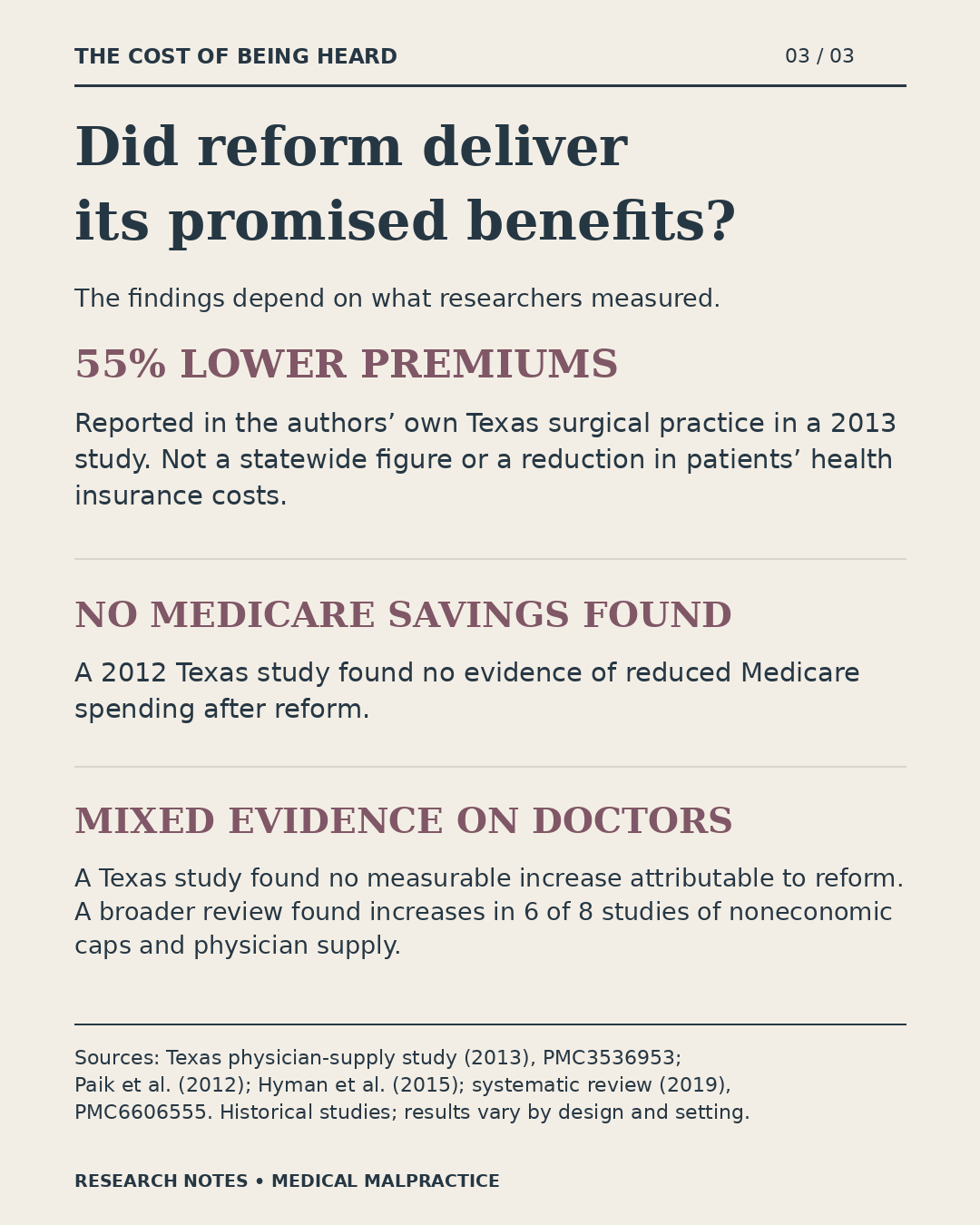
Some benefits are easier to document than others. In a study published in 2013, researchers reported that malpractice premiums in their own Texas surgical practice had fallen by 55 percent after reform. That is a substantial reduction. It is also one practice’s experience, not a statewide measurement of savings for patients. [5]
A doctor’s malpractice premium and a family’s health insurance premium are two different bills.
The theory was that reducing legal exposure would eventually make care cheaper. Doctors would spend less protecting themselves against lawsuits, and those savings would reach the health care system.
Texas research makes that promise harder to celebrate without qualification.
A study published in 2012 found no evidence that the state’s reforms reduced Medicare spending. A separate study published in 2017 examined the medical claims costs incurred by private health insurers and found little effect from the reforms. Neither study proves that no patient ever benefited. Both challenge the assumption that reducing malpractice liability necessarily produces broad savings in the cost of care. [6] [7]
Then there is “defensive medicine”—tests and procedures ordered primarily to protect against litigation.
A 2014 study examined emergency-care liability reforms in Texas, Georgia, and South Carolina. It found no reduction in CT or MRI use or hospital admissions in any of the three states, and no reduction in emergency-department charges in Texas or South Carolina. Georgia did see a modest reduction in charges. This study examined changes to emergency-care liability standards rather than isolating damage caps, but it tested a central promise: making doctors harder to sue would change how much care they ordered. In those settings, that promise largely failed to materialize. [8]
The claim that reform brought more doctors also requires care.
Counting more doctors after a law changes is a starting point. To understand whether the law caused the increase, researchers have to consider population growth, existing trends, and what happened elsewhere.
A Texas study published in 2015 found no measurable increase in physician supply attributable to reform. The broader research is more favorable in some settings: a 2019 systematic review found that six of eight studies examining noneconomic-damage caps and physician supply reported increases. The review also found evidence of reduced spending and defensive medicine across some studies. Those findings deserve acknowledgment, even when they complicate my argument. [9] [10]
What that review did not establish was an overall improvement in quality of care from those caps. Having more physicians, spending less, and keeping patients safer are separate outcomes. Success in one does not prove success in the others. [10]
I am willing to acknowledge savings for physicians and evidence of benefits in some settings. I also want the costs borne by injured patients included in the accounting.
The difficulty finding representation. The limits on compensation. The effort of repeatedly exposing a private trauma while trying to recover.
From inside that system, I want to ask a different question: How much capacity do we assume an injured person has?
During my recovery, I spent nearly nine months in inpatient rehabilitation and more than a year working with physical and occupational therapists at home. There were appointments, setbacks, progress, and more setbacks. There was the practical work of getting through each day and the emotional work of realizing how much had changed.
There was also being a mother.
My children still needed me while I was trying to understand how close I had come to leaving them.
Finding words for it happened slowly.
There were things I could describe medically before I could acknowledge what they meant to me. I could name a complication without being ready to talk about the fear. I could explain a loss of function without being ready to unpack the grief.
Being able to give a medical history is not the same as being ready to tell your story.
And neither necessarily means you have the energy to gather records, research attorneys, complete forms, follow up, and absorb another rejection.

I am not asking anyone to assume that every surgical complication is malpractice. I am asking us to consider whether access to accountability should depend so heavily on how quickly someone can become an organized advocate while recovering from the very harm they want investigated.
A person can be fighting for their life while a deadline approaches.
A person can be working desperately toward recovery without having begun to process what happened.
A person can want answers long before they can bear to ask the questions out loud.
We talk about giving people time to heal as though we mean it. Then we build systems that expect them to be ready to recount, document, and defend their suffering on a schedule.
For me, two years was not an abundance of time.
It was the time it took to begin finding words.
By then, I understood that I had missed the deadline for pursuing the events that first turned my life upside down. I was still living with the consequences. I was only beginning to speak about them.
That gap—between being alive and being ready—is what I want the conversation about tort reform to include.
The studies can count claims, payments, and rejected cases. They cannot tell you what it felt like to wait for someone’s finger to reach the next letter.
They cannot tell you what it costs me to write about a box prepared for my children in case I died.
I can try.
But even today, I am having trouble talking enough to get this written.
Before anyone asks why it took me so long, I wish they understood what it took to say anything at all.
Sources
1. Texas filing deadline, §74.251
2. Shepherd (2014), Uncovering the Silent Victims of the American Medical Liability System
3. Texas medical liability law, §74.301
4. Sage, Harding & Thomas (2016), Resolving Malpractice Claims after Tort Reform
5. Texas physician-supply and premium study (2013)
6. Paik et al. (2012), Will Tort Reform Bend the Cost Curve?
7. Born, Karl & Viscusi (2017), Private health insurance costs
8. Waxman et al. (2014), Emergency Department Care


Leave a Reply