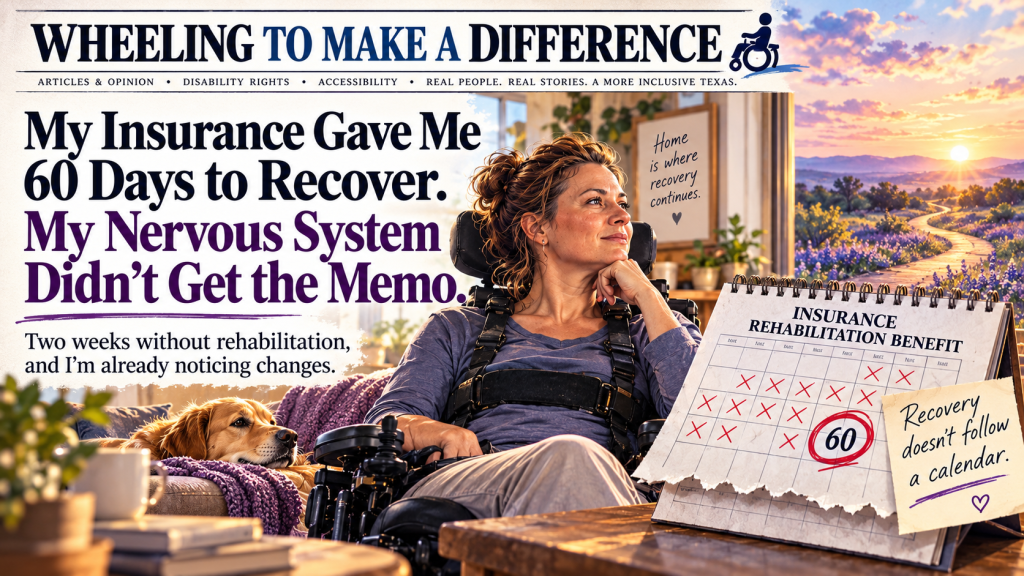
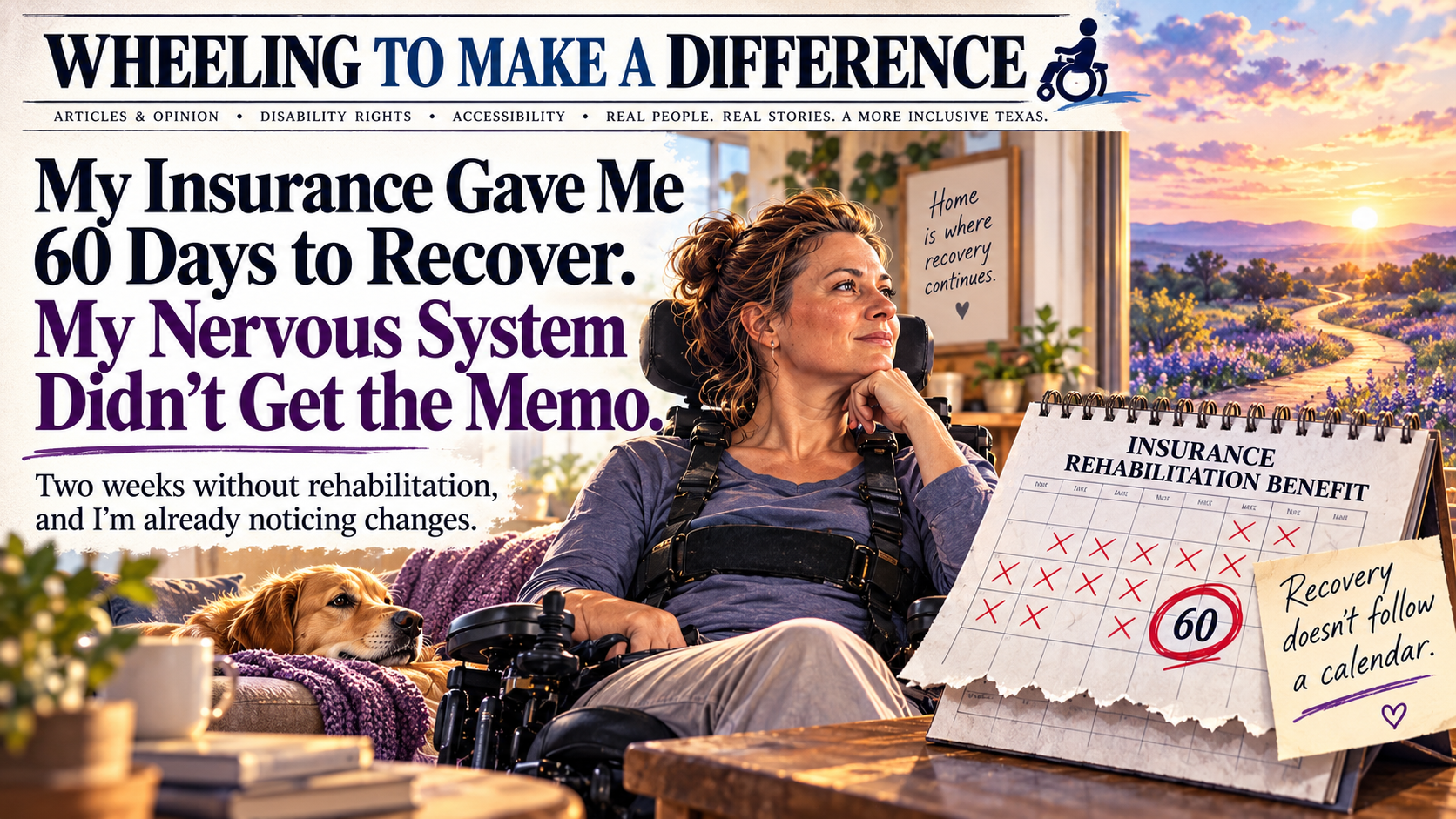
Two weeks without rehabilitation, and I’m already noticing changes. Why should an insurance policy determine how long someone gets to fight for their independence?
There is something particularly cruel about fighting for every inch of progress, only to discover that the clock has run out. Not your body’s clock. Your insurance company’s. After complications from neurosurgery left me quadriplegic, I spent approximately nine months in inpatient rehabilitation, followed by more than a year receiving rehabilitation at home. I’ve worked through pain, spasticity, exhaustion, and the frustration of trying to convince my body to respond to commands that once came effortlessly. And I’m still recovering. But now I’m facing the loss of insurance-covered rehabilitation because I’ve exhausted my 60-day benefit. Sixty days. As though the human nervous system follows a neat little calendar. My medical needs haven’t disappeared. My coverage has.
This Is Rehabilitation, Not General Home Health Care
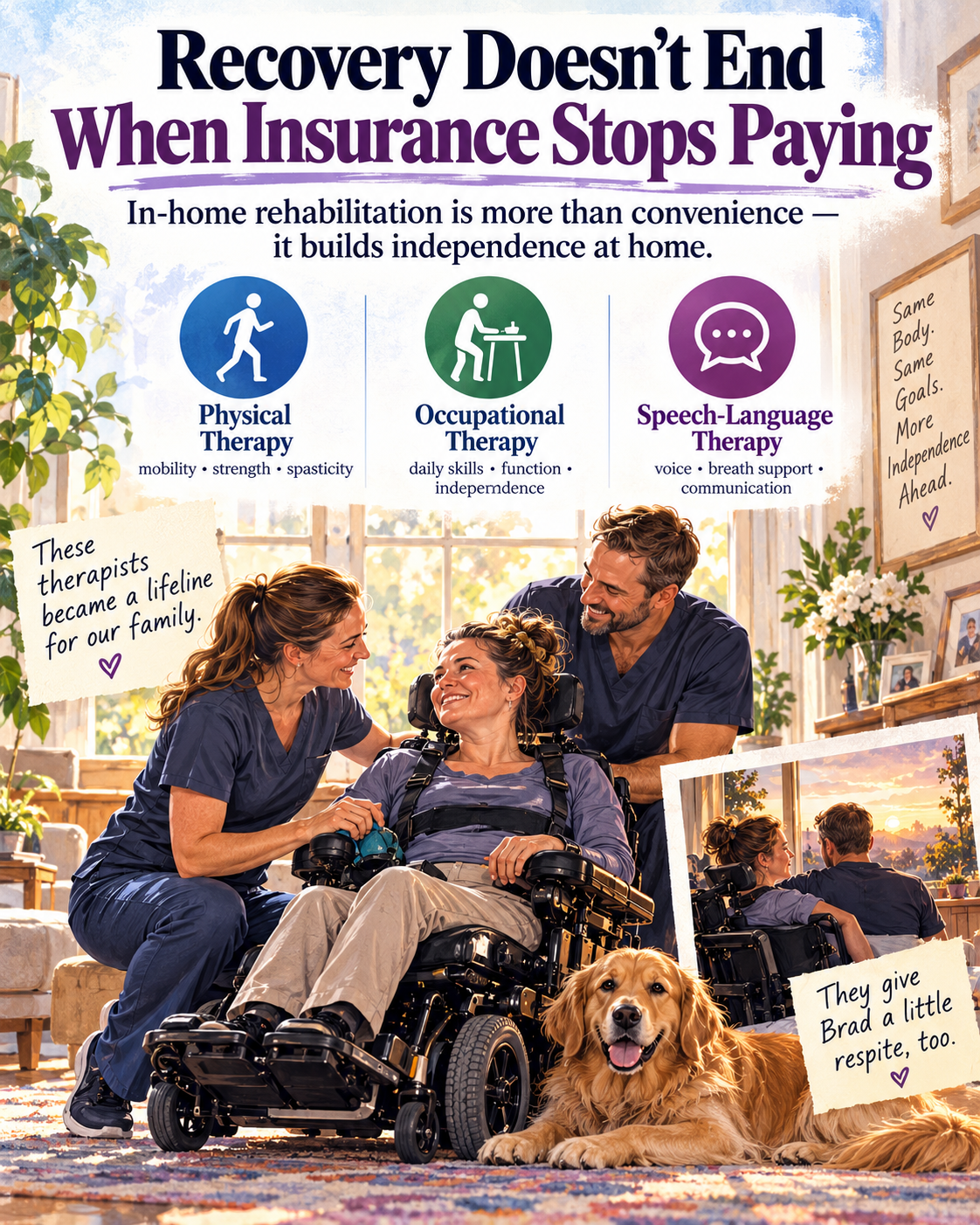
When I talk about in-home rehabilitation, I’m talking about skilled treatment from licensed physical therapists, occupational therapists, and speech-language therapists—not routine nursing visits, household assistance, or personal care. Physical therapy addresses mobility, strength, balance, positioning, and spasticity. Occupational therapy helps people regain or adapt skills for daily activities. Speech-language therapy can address communication, voice, swallowing, and breath support for speaking. These treatments may be delivered through a home health agency, but rehabilitation is a distinct service. I’m not asking for convenience. I’m asking for specialized care that helps me regain and preserve abilities I’ve spent years fighting to recover.
The Work Nobody Sees
For someone recovering from catastrophic neurological complications, rehabilitation can mean learning to hold your head upright, shifting your weight, or persuading a muscle to respond. Sometimes you work for weeks toward a movement so small that someone else might not notice. But you notice. Your therapist notices. And suddenly that movement represents possibility. Progress isn’t always measured in steps. Sometimes it’s measured in centimeters, seconds, or doing one more thing for yourself than you could yesterday.
There Were Days I Barely Made It Through Therapy at Home
For people with significant disabilities, getting to an outpatient appointment can be an undertaking: transportation, wheelchair accessibility, pain, fatigue, spasms, and medical needs—all before treatment begins. There were days I barely had the energy to participate in therapy in my living room. I certainly couldn’t have made it to an outpatient clinic. Not because I lacked motivation, but because sometimes my body didn’t have enough energy to do both. The energy required to access healthcare can be the very energy you need for the treatment. Home rehabilitation meant I still had an opportunity to try.
Independence Begins at Home
A clinic can measure how long I maintain my balance. At home, that balance means feeling safer in my wheelchair. Holding my head upright means looking at my children during a conversation. Strengthening my arms means the possibility of reaching for something without immediately asking for help. My therapists know the layout of my home, my equipment, and the obstacles of everyday life. We’re not just practicing exercises and hoping they’ll translate into living. We’re working on life itself. Independence doesn’t always mean doing everything alone. Sometimes it means directing your care or participating more actively in a transfer.
The Therapists Who Became Our Lifeline
Somewhere along the way, my in-home therapists stopped feeling like people who simply came to our house for appointments. They became part of our family. They’ve seen us at our best, our most chaotic, and through some of our hardest moments. They’ve celebrated tiny victories and understood the exhaustion behind the smiles. During a particularly difficult period in our family, their familiarity with our home and circumstances meant they noticed things someone seeing me briefly in a clinic might never have seen. They offered compassion and support. These therapists have been a lifeline for our entire family—not just me.
A Little Breathing Room for Brad
My husband Brad is my primary caregiver. Transfers, positioning, medications, personal care, appointments, and countless other tasks shape his days. The therapists’ visits give him a little breathing room—not formal respite care, but moments when another trusted professional is helping me work toward independence. They’ve also helped him understand my changing abilities and how to support my progress. You cannot put a billing code on trust. That doesn’t mean it has no value.
When a Coverage Limit Becomes a Medical Decision
Some insurance policies impose fixed therapy limits; others permit additional treatment when medical necessity is demonstrated, subject to their terms. Two people with similar injuries can face very different coverage decisions. I am not asking for unlimited therapy without medical justification. I’m asking why my continuing access shouldn’t depend on documented medical need rather than an inflexible deadline. Sixty days is an insurance benefit limit. It isn’t proof that my recovery is complete.
Apparently, My Best Option Is to Leave My Family
My doctor had already submitted a request for additional rehabilitation days, so I called my insurance company to find out what was happening. I explained that getting to outpatient therapy is difficult for me. With my physical limitations and transportation barriers, it’s not as simple as getting in the car and showing up.
Their response? My best option would be inpatient rehabilitation.
Think about that. I called to ask for more time with the skilled therapists helping me recover at home, and the alternative offered was to leave my husband, my children, and my everyday life to stay in a rehabilitation facility. Apparently, the solution to my accessibility problem is to remove me from my home entirely.
I’ve already spent enough time in hospitals. My family has already endured enough separation. And let’s talk about the financial logic. I don’t know exactly what another inpatient stay would cost, but I have a hard time understanding why a potentially more expensive, more disruptive option makes better sense than continuing the skilled rehabilitation already helping me at home.
Would I receive better care? Not necessarily. Would I have the same independence, comfort, and dignity? I have serious doubts. Since when did keeping a disabled person at home with their family become the unreasonable option?
I’m not arguing that inpatient rehabilitation is unnecessary. It can be lifesaving, and I’ve benefited from it myself. I’m arguing that the appropriate setting for rehabilitation should be determined by a patient’s medical needs and circumstances—not simply by which coverage category still has days available.
Home isn’t an obstacle to my recovery. It’s where my recovery becomes a life.
Two Weeks. That’s All It Took.
It’s been just two weeks without therapy, and I’m noticing changes in my mobility and spasticity. Movements I’ve worked hard to regain feel more challenging. My voice and breath support have also been a concern. My breath support began declining before a suspected viral infection complicated matters; my doctor evaluated me and prescribed steroids. I had already recognized that I needed speech-language therapy again. I cannot say with certainty how much of these changes relates to interrupted rehabilitation, my underlying neurological condition, or other factors. But I can tell you what it feels like: watching progress you’ve spent years fighting for begin to slip through your fingers. Every setback carries extra fear when you remember what it took to regain even a little control.
A Thank-You to Rehab Without Walls
I also want to acknowledge Rehab Without Walls, the organization behind my in-home rehabilitation team. The therapists who have come into our home have worked with me through difficult days and small victories alike. They have seen the work recovery takes when it happens in the middle of ordinary family life, not just inside a clinic. I’m grateful for the care, encouragement, and consistency they have brought to our household.
That gratitude is part of why the loss of therapy has been so difficult. Recognizing the people who helped me progress does not change the larger question: why does insurance get to decide that sixty days is enough?
I Am Not Finished Recovering
I’ve survived things I once believed would kill me. I’ve spent months in hospitals and worked to rebuild a life that looks nothing like the one I had before. I know medicine has limits. But I’m still learning, adapting, and fighting for independence. I don’t need anyone to promise I’ll walk again. I don’t need false hope. I need the opportunity to discover what my body is still capable of doing. My therapists have helped me reclaim pieces of my life and made rehabilitation possible on days when leaving home wasn’t. Apparently, my insurance company and my nervous system are operating on two very different recovery schedules. Unfortunately, only one of them gets to decide when coverage stops. My recovery isn’t over just because the funding is.


Leave a Reply