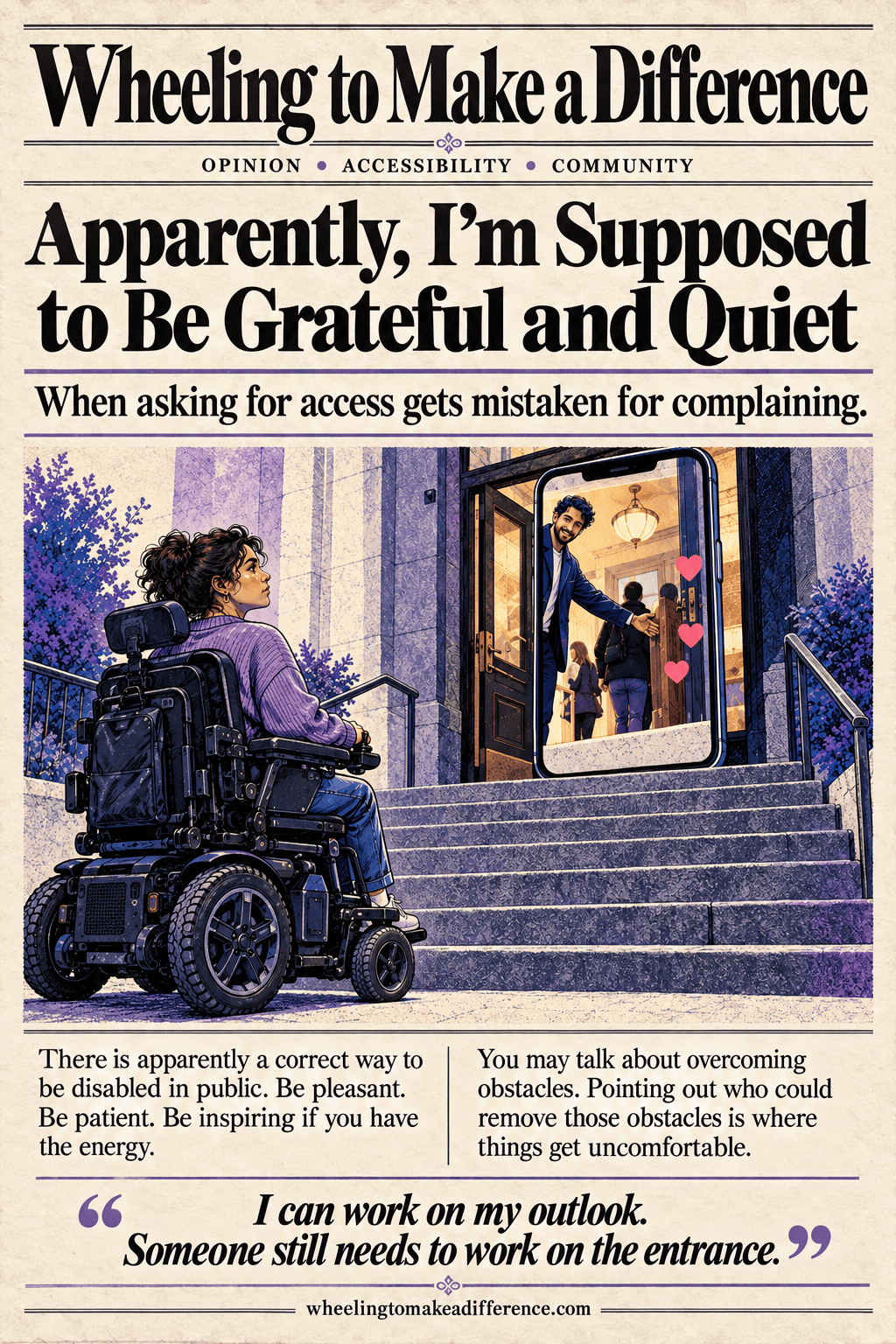
On toxic positivity, the difference between complaining and advocacy, and a world that wants disability stories to feel good.
There is apparently a correct way to be disabled in public.
Be pleasant. Be patient. Be inspiring if you have the energy. Thank everyone for trying, even when trying has not resulted in your being able to enter the building.
You may talk about overcoming obstacles. Pointing out who could remove those obstacles is where things get uncomfortable.
Then you are complaining.
And if you keep asking? You are difficult. Negative. Ungrateful.
But this goes beyond how disabled people are expected to behave. It is also about what people are willing to watch, read, and respond to.
A story about someone helping a wheelchair user through a doorway offers a satisfying moment. A story asking why that person cannot get through the doorway independently asks something more of the audience.
One lets us feel good about the world.
The other asks us to help change it.
I found a community I never knew I needed

I never expected to become part of the disabled community. There was no application process, although there has certainly been enough paperwork.
But here I am, finding something deeply valuable in a life I did not anticipate: people who understand.
People who understand why a seemingly small barrier can unravel an entire day. Why canceled plans can involve much more than disappointment. Why getting out of the house sometimes deserves its own project manager.
People who can celebrate a gain in function without requiring you to pretend everything else is fine.
There is something profoundly comforting about being able to say, “This is hard,” and hear, “I know,” instead of receiving an unsolicited assignment to count your blessings.
I am grateful for the humor, ingenuity, solidarity, and generosity I have found in this community.
I can also be furious about how its members are treated.
Belonging to this community gives me more reasons to speak up. Once you recognize how many people are navigating the same barriers, it becomes harder to accept those barriers as your own private inconvenience.
And this community is hardly small. According to CDC data from the 2022 Behavioral Risk Factor Surveillance System, 12.2% of U.S. adults—about 1 in 8—reported a mobility disability, meaning serious difficulty walking or climbing stairs. That measure does not include every kind of physical disability, but it makes one thing clear: access is an everyday concern for a substantial part of our country.
When positivity becomes another barrier
Encouragement can be loving. Hope can sustain us. There are days when a kind word helps more than the person saying it realizes.
But positivity becomes toxic when it leaves no room for the truth.
“At least you’re alive.”
“Focus on what you can do.”
“Other people have it worse.”
These statements may be intended to comfort. In response to an accessibility concern, they can also end a conversation that needs to happen.
A blocked entrance does not become usable because I have adjusted my perspective. A telephone system does not suddenly respond to my physical abilities because I remembered that someone, somewhere, has a harder life.
I can work on my outlook. Someone still needs to work on the entrance.
And that same pressure to stay positive can shape the stories an audience is willing to hear. We can share the triumph, but apparently we should edit out the unanswered requests, the exhaustion, and the entirely preventable barrier that made the triumph necessary.
Please enjoy our struggle responsibly
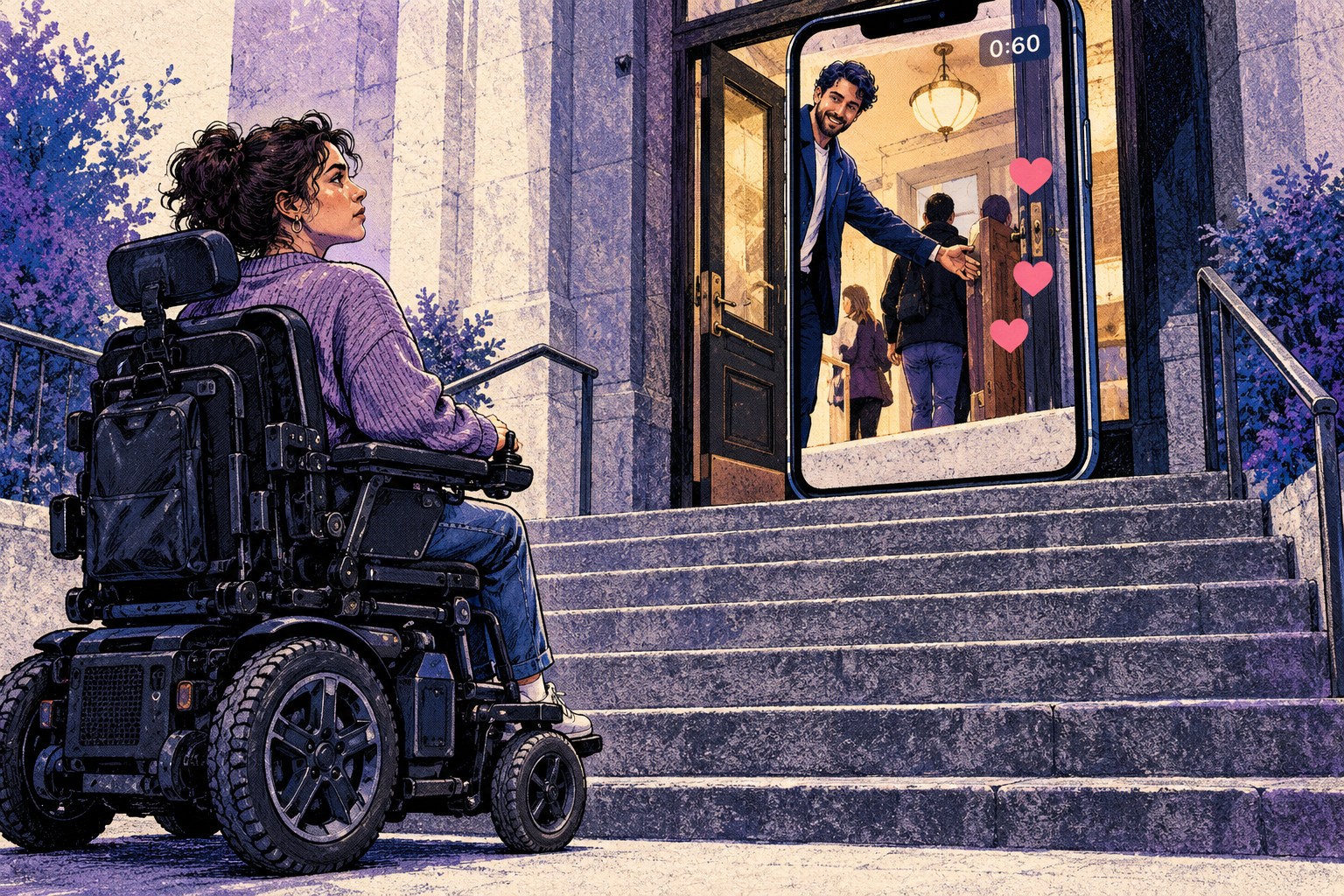
What troubles me is the appetite for disability stories that make the audience feel good about itself.
The heartwarming gesture. The stranger who steps in. The moment that lets someone comment, “Faith in humanity restored,” and continue scrolling.
There is nothing wrong with appreciating kindness. I appreciate it, too.
But I want us to notice where our attention stops.
Do we care about what happens after the video ends? Whether the person can return tomorrow without needing a rescue? Whether they have access to transportation, communication, or the support that makes an ordinary day possible?
Would we click if the headline asked us to help fix the problem?
Would we keep reading if the disabled person sounded angry instead of grateful?
Those questions matter because the stories we reward tell people which parts of their lives are welcome in public.
If we only engage when disability makes us feel inspired, we are asking disabled people to make their experiences emotionally convenient for everyone else.
We become visible as an opportunity for someone to feel compassionate, then disappear when we ask for sustained attention or change.
The person opening the door gets applause. The person asking for an automatic door gets a lecture about the budget.
Sixty seconds or less, please
Sometimes it feels like there are submission guidelines for being heard: sixty seconds or less, a fifth-grade reading level, and a happy ending.
Preferably with music.
There is nothing wrong with short videos or plain language. Making information easier to understand is part of accessibility. People have different reading abilities, energy levels, and ways of processing information.
But making a story understandable should not mean removing everything complicated from it.
Some experiences need more than a minute. Explaining why a system fails can take longer than filming one person helping someone through it.
A cheerful clip can show the solution to today’s problem. Understanding why the same problem will happen tomorrow requires a little more attention.
I do not expect everyone to read every essay or watch every video. Nobody has that capacity. But we can examine the habit of stopping only for stories that reward us emotionally while scrolling past the ones that ask something of us.
If the only disability stories we make time for are the ones that reassure us how kind the world is, we are going to miss an awful lot about living in it.
Complaining and advocacy are not the same thing
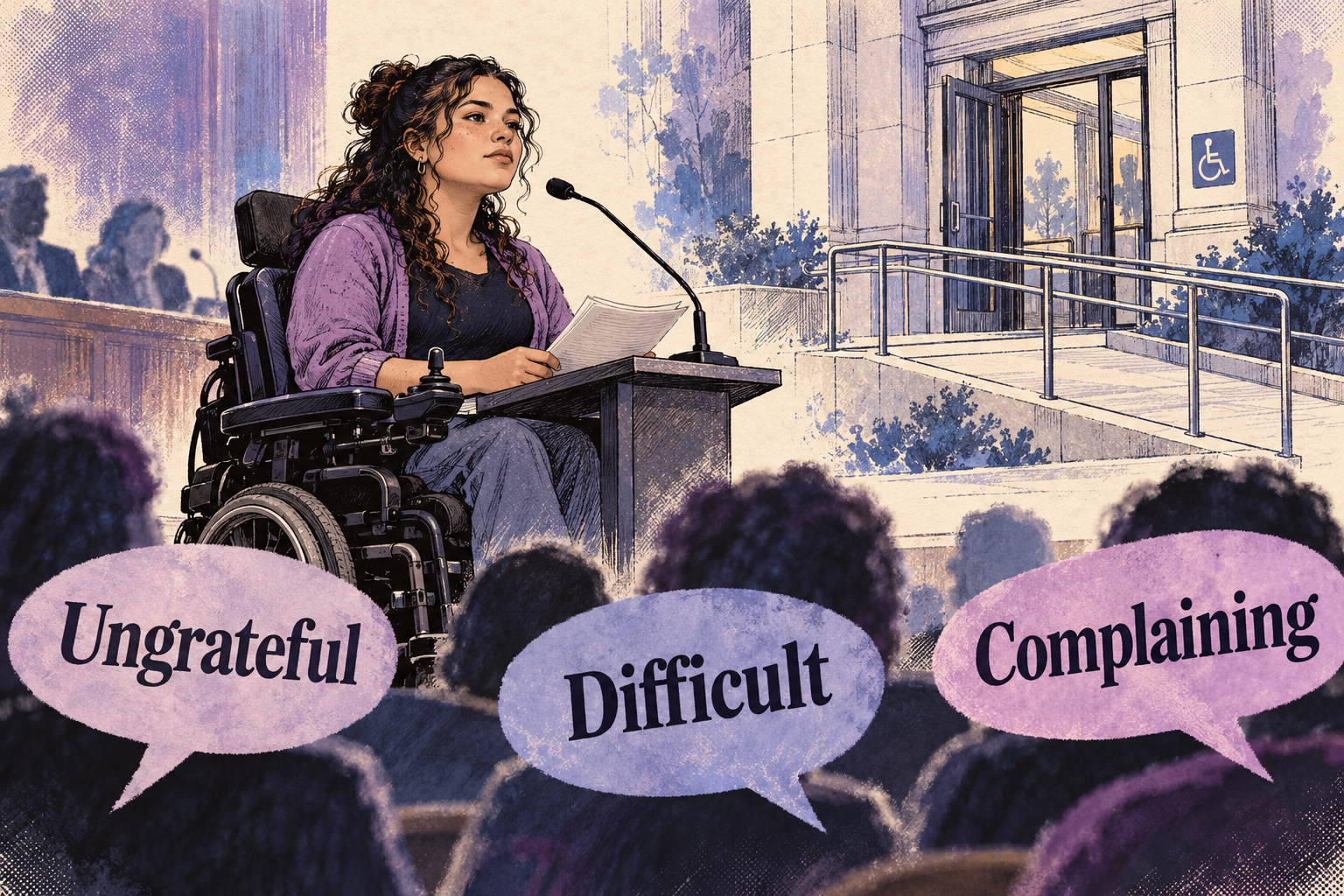
When I explain that I cannot use a service, identify what is preventing me from using it, and ask for a workable alternative, I am advocating.
When I follow up because nothing has changed, I am still advocating.
When other people would benefit from the same change, the issue extends well beyond whether I personally had a frustrating Tuesday.
Advocacy does not always sound cheerful. Sometimes it sounds exhausted because the person speaking has already explained the problem five times.
And disabled people are allowed to express frustration without presenting a complete solution. We should not have to arrive with a polished proposal and a funding strategy to say, “I cannot get inside.”
The usefulness of that information does not depend on how pleasantly it is delivered.
You can dislike someone’s tone and still address the barrier they identified.
Being nice is not an accessibility strategy
There is a particular irony in asking disabled people to advocate for ourselves, then criticizing us the moment that advocacy makes someone uncomfortable.
Speak up—but gently. Ask for change—but don’t pressure anyone. Tell your story—but make it inspiring.
We are encouraged to find our voices, provided we keep the volume low enough that nobody has to stop what they are doing.
Being quiet and nice has never, by itself, brought about real change—let alone made an inaccessible doorway wider.
Change takes people willing to name a problem, challenge an excuse, and keep asking after everyone else would prefer to move on. It also takes people willing to listen, accept responsibility, and act.
Kindness matters. But kindness does not require silence, and politeness should never be the admission price for being heard.
If an accessibility request only feels acceptable when it asks nothing of anyone, what exactly are we being given permission to advocate for?
We make the perfect scapegoat
An accessibility problem can involve years of neglected planning, decisions made without disabled people in the room, or responsibility passed between people who each insist it belongs to someone else.
Blaming one person’s attitude is considerably easier.
The stairs have been there for years. The person pointing out that they cannot climb them arrived five minutes ago.
Somehow, the newcomer is the problem.
Once we are labeled ungrateful, people can discuss our manners instead of the missing access. They can defend good intentions without examining whether the help actually worked.
“Someone tried to help you.”
Yes. And I appreciate that. I still need to get through the door.
Before making a request, we can find ourselves doing an extraordinary amount of work to make it comfortable for everyone else.
Start with a thank-you. Add an apology. Acknowledge the expense. Explain that we understand people are busy. Add another thank-you in case the first one has expired.
By the time we reach the actual request, we have written a small acceptance speech.
All this to ask about the bathroom.
I would like every outing to stop becoming an advocacy opportunity.
Sometimes I would like it to become lunch.
A community worth listening to
One of the things I treasure about the disabled community is the knowledge people share: a tool that makes a task possible, a different way to communicate, the question someone finally learned to ask.
That knowledge deserves a place in the decisions that shape our lives.
Listen when disabled people explain what does not work. Include us before the system is built. Pay us for the expertise being requested. When a solution falls short, let us say so without treating the feedback as a personal betrayal.
And when we celebrate our lives, please do not use that joy as evidence that we no longer need anything to change.
Our happiness does not certify that everything is accessible. Our resilience does not excuse leaving us to struggle.
I am grateful to have found this community. I wish the world made belonging to it less exhausting.
I want us to have more freedom, more support, and more ordinary days when nobody has to fight to participate.
I can be grateful for the people beside me and still demand better from the systems around us.
You may call that complaining.
I would be delighted to retire the subject once I can get through the door.


Leave a Reply