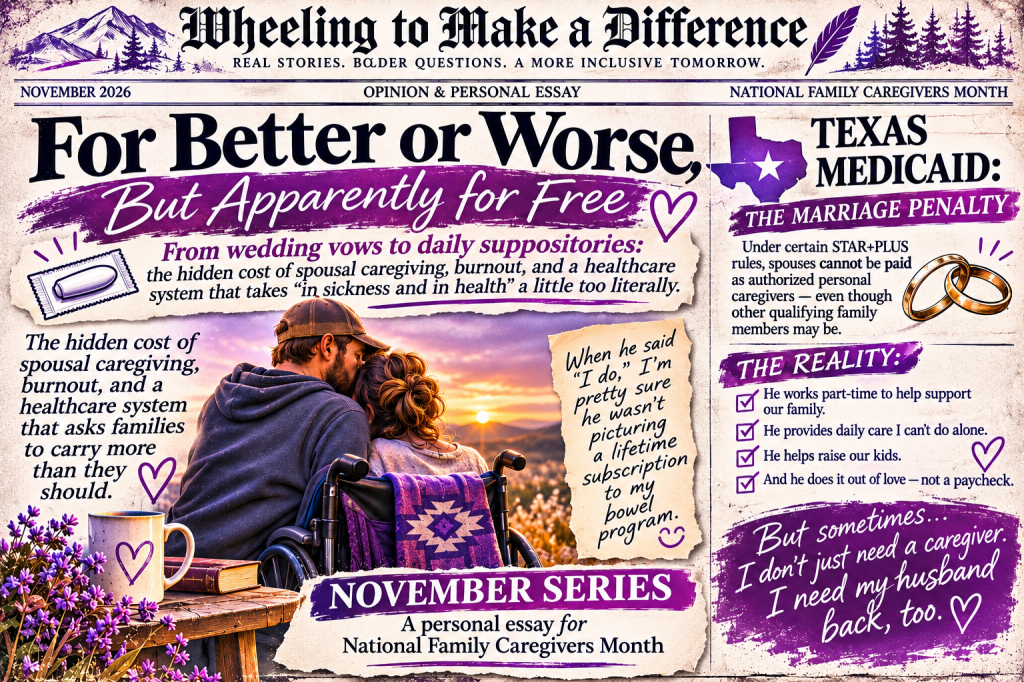
From wedding vows to daily suppositories: the hidden cost of spousal caregiving, burnout, and a healthcare system that takes “in sickness and in health” a little too literally.
By Danielle Tyler | Wheeling to Make a Difference | November Series
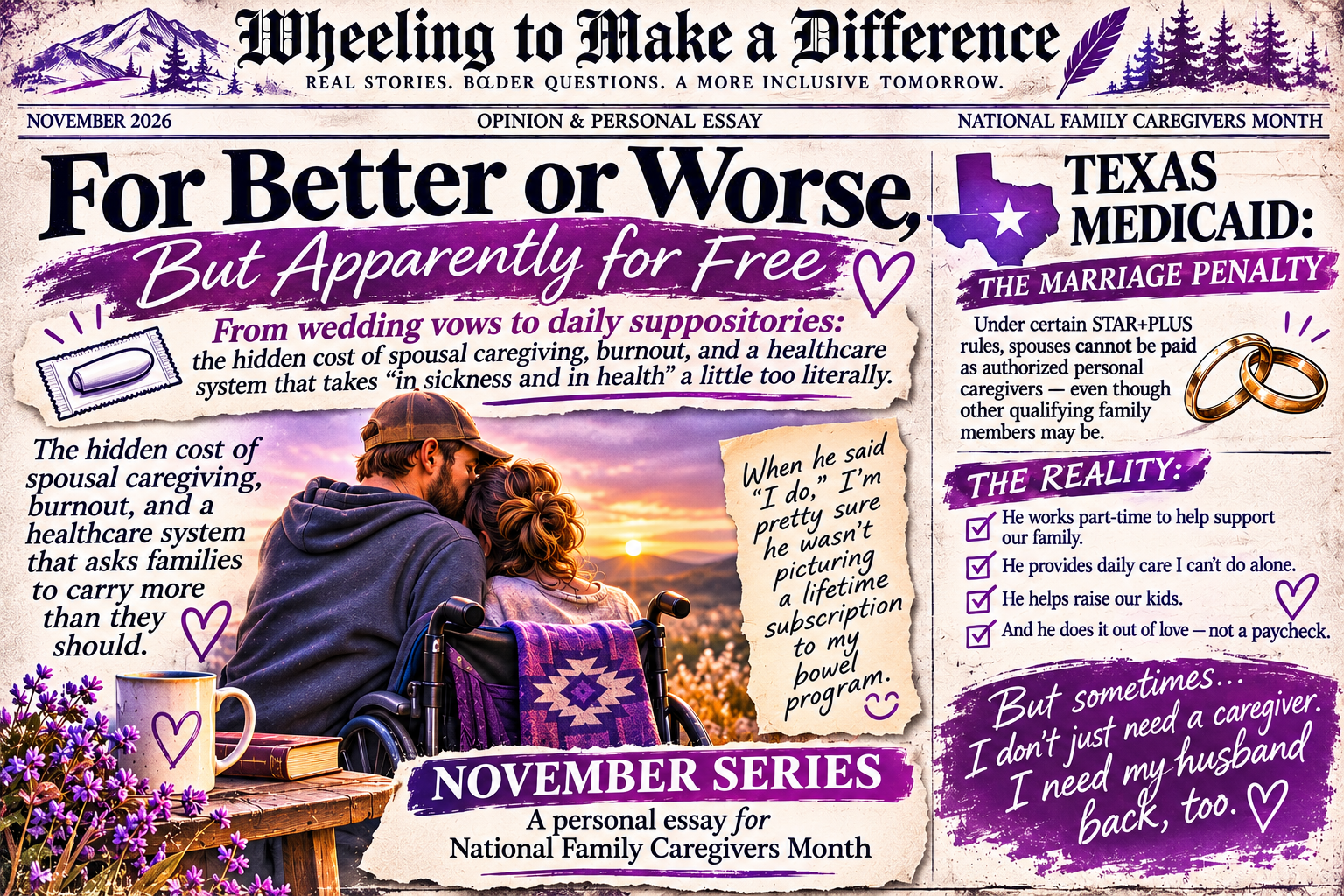
When my husband and I exchanged wedding vows, I’m fairly certain neither of us envisioned the words “in sickness and in health” eventually including a daily suppository.
Nothing says romance quite like your husband being responsible for your bowel program.
Hallmark really missed an opportunity with that one.
But somewhere between the medications, transfers, appointments, and the thousand little things that go into keeping me alive and functioning, our marriage became something neither of us had anticipated.
My husband became my caregiver.
And apparently, according to certain Texas Medicaid rules, that means his labor is worth less because he happens to be married to me.
Texas Medicaid and the Marriage Penalty
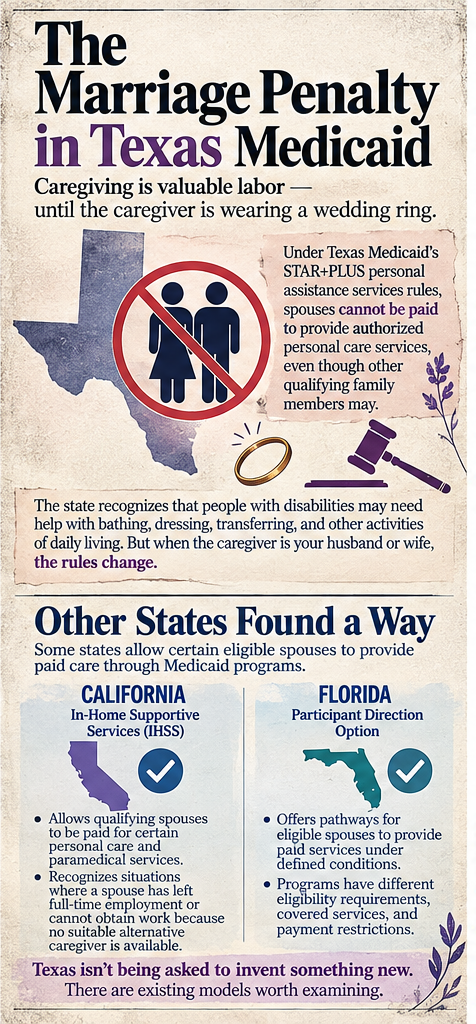
Under Texas Medicaid’s STAR+PLUS personal assistance services rules, a spouse cannot be paid to provide certain authorized caregiving services, even when other qualifying family members may be eligible.
Think about that for a moment.
The state recognizes that someone with significant disabilities may need assistance bathing, dressing, transferring, using the bathroom, and performing everyday activities.
It recognizes that providing these services is work.
It may even pay someone else to do that work.
But when the person providing that care is your husband or wife, the rules change.
Apparently, love is priceless. Labor, on the other hand, depends on whether you’re wearing a wedding ring.
I’m not arguing that every loving act within a marriage deserves a paycheck. I’m arguing that when a spouse performs the equivalent of a professional caregiver’s job because no adequate alternative exists, pretending that labor has no economic value is absurd.
And it doesn’t become less absurd just because we’ve learned to live with it.
When Your Spouse Becomes Your Caregiver
Before I became quadriplegic, my husband and I had a very different relationship with the world.
We were partners raising children, managing a household, working, making plans, and dealing with the ordinary chaos of family life.
Now our days revolve around a schedule that most families never have to consider.
My husband helps me with the physical tasks I can no longer perform independently. He manages responsibilities that extend far beyond the typical expectations of marriage, while continuing to work part-time and help raise our children.
He is my husband, my caregiver, my teammate, and frequently the person holding everything together when the rest of our lives feel like a poorly organized circus.
And he does it remarkably well.
That doesn’t mean it’s easy.
It doesn’t mean he never gets frustrated, exhausted, or overwhelmed. It certainly doesn’t mean he has an unlimited supply of patience.
He’s human.
So am I.
Yet disability policy often seems to operate on the assumption that family caregivers are an endlessly renewable resource.
They’re not.
The Price of Care
Consider what families would face if they had to purchase every hour of care their loved ones needed.
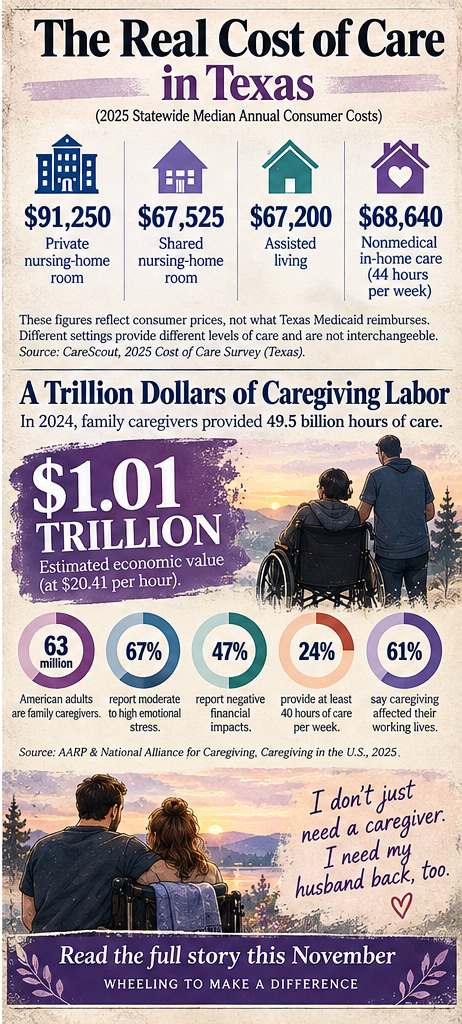
According to CareScout’s 2025 Texas cost-of-care figures, median annual consumer costs included:
- $91,250 for a private nursing-home room.
- $67,525 for a shared nursing-home room.
- $67,200 for assisted living.
- $68,640 for nonmedical in-home care at 44 hours per week.
These are consumer cost estimates, not what Medicaid pays providers. The care settings also aren’t interchangeable.
But the figures demonstrate something important: assistance with daily living has substantial economic value.
That value doesn’t magically disappear when the caregiver shares a last name, a mortgage, or a wedding anniversary with the person receiving care.
And those figures don’t begin to account for what happens when someone needs help throughout the day and night.
A Trillion-Dollar Workforce Nobody Wants to Pay
Family caregiving isn’t a small, unusual arrangement happening in a few households.
It’s an enormous part of how American healthcare functions.
AARP and the National Alliance for Caregiving estimated that approximately 63 million American adults were family caregivers in 2025.
Their research also found that:
- 67% reported moderate to high emotional stress.
- 47% experienced negative financial impacts.
- 24% provided at least 40 hours of care per week.
- 61% experienced work-related impacts because of caregiving.
AARP separately estimated that family caregivers provided 49.5 billion hours of care in 2024, representing approximately $1.01 trillion in economic value.
These national statistics describe family caregivers broadly, not just spouses.
Still, they raise a rather uncomfortable question.
If unpaid caregivers are contributing an estimated trillion dollars’ worth of labor, how much of our healthcare system is being held together by people who are simply too exhausted, too loyal, or too financially trapped to stop?
We call them heroes. We celebrate their devotion. We tell them how lucky their loved ones are.
Then we send them home to figure out how to pay the electric bill.
Other States Have Found Ways
Texas isn’t the only state with complicated Medicaid rules. But the exclusion of spouses from certain paid caregiving arrangements isn’t a universal requirement across the country.
California’s In-Home Supportive Services program permits eligible spouses to provide paid care under specific circumstances.
Florida also has Medicaid arrangements that may permit qualifying spouses to provide paid services under defined conditions.
These programs have different eligibility requirements, covered services, and payment restrictions.
I’m not suggesting either state has perfected caregiving.
I’m suggesting the idea of compensating a spouse for necessary care is neither radical nor impossible.
Other states have already demonstrated that there are ways to recognize this work.
Texas could examine those models.
Ninety Days Is a Long Time When You Need Help Today
I recently went through an evaluation with Texas Health and Human Services to determine whether I might qualify for additional assistance.
Community Attendant Services was discussed as a possibility, although my eligibility has not yet been determined.
I was told the process could take approximately 90 days.
Ninety days.
That’s three months of continuing to need help with the same basic activities of daily living while waiting to find out whether additional support will become available.
My disability doesn’t take a vacation while paperwork is being processed.
My husband’s responsibilities don’t pause.
And our family doesn’t suddenly acquire more hours in the day.
I understand that eligibility determinations take time. But when someone needs daily assistance, delays aren’t just administrative inconveniences.
They’re lived experiences.
They affect people’s health, finances, relationships, and ability to remain safely at home.
I Want My Husband Back, Too
This is the part that is harder to write.
Because as much as I want policymakers to understand the financial cost of unpaid caregiving, there’s another cost that doesn’t fit neatly into a government spreadsheet.
I miss being just a wife.
I don’t mean that I want my husband to stop helping me. I am deeply grateful for everything he does, and I know how fortunate I am to have a partner who continues showing up.
But sometimes I don’t want our next conversation to be about medications, appointments, therapy, transfers, or which task needs to happen before bedtime.
Sometimes I want to talk about absolutely nothing important.
I want us to laugh about something ridiculous.
I want us to have moments that belong to our marriage instead of my medical needs.
I want him to be able to relax without constantly wondering whether I need something.
And I want to feel like his partner, not another responsibility on an already overflowing list.
Sometimes I don’t just need a caregiver. I need my husband back, too.
I suspect there are countless couples living some version of this experience.
Some are caring for spouses with dementia, cancer, neurological conditions, or injuries. Others are navigating progressive illnesses or disabilities that require years of ongoing assistance.
Every relationship is different.
But the emotional balancing act can be painfully familiar.
How do you remain romantic partners when one person must also perform intimate, physically demanding care?
How do you protect a marriage when both people are exhausted?
How do you make room for ordinary affection when so much of your day revolves around survival?
Love helps.
But love doesn’t create additional hours, replace lost income, or guarantee respite.
Caregiver Burnout Isn’t a Failure of Love
We need to stop treating caregiver burnout as though it means someone doesn’t love their family enough.
Exhaustion is not a character flaw.
Frustration is not abandonment.
And needing help does not mean a family has failed.
My husband and I can love each other deeply and still acknowledge that our circumstances are difficult.
We can be grateful for what we have while advocating for what we need.
Those things are not mutually exclusive.
The answer to caregiver burnout cannot simply be telling families to practice more self-care.
Self-care is difficult to schedule when someone needs assistance getting out of bed, eating, using the bathroom, or moving safely throughout their home.
A bubble bath isn’t a replacement for a trained attendant.
Neither is a motivational quote.
In Sickness and in Health Shouldn’t Mean Without Support
During National Family Caregivers Month, we’ll hear plenty about the incredible sacrifices caregivers make.
And they deserve recognition.
But recognition without meaningful support can become another form of empty gratitude.
I don’t want my husband to be praised for working himself into exhaustion.
I want him to have the support necessary to remain my husband, my partner, and the father of our children without being expected to function as an entire healthcare workforce.
I want families to have real choices about how care is provided.
I want disability policy to recognize that keeping someone at home with their family should not require financially and emotionally exhausting the people who love them.
And I’d like policymakers to recognize that marriage is not an unlimited supply of free labor.
After all, when we said “for better or worse,” neither of us realized we’d apparently signed a subcontract with the State of Texas.
We promised to care for one another in sickness and in health.
We never promised to replace an entire healthcare system.
Part of the November Series at Wheeling to Make a Difference, recognizing National Family Caregivers Month and examining the real experiences of family caregivers, disabled people, and the families navigating care together.
Research referenced: AARP and National Alliance for Caregiving, Caregiving in the U.S. 2025; AARP’s 2026 valuation of unpaid family caregiving; CareScout’s 2025 Texas Cost of Care Survey; Texas Medicaid STAR+PLUS personal assistance services rules.


Leave a Reply