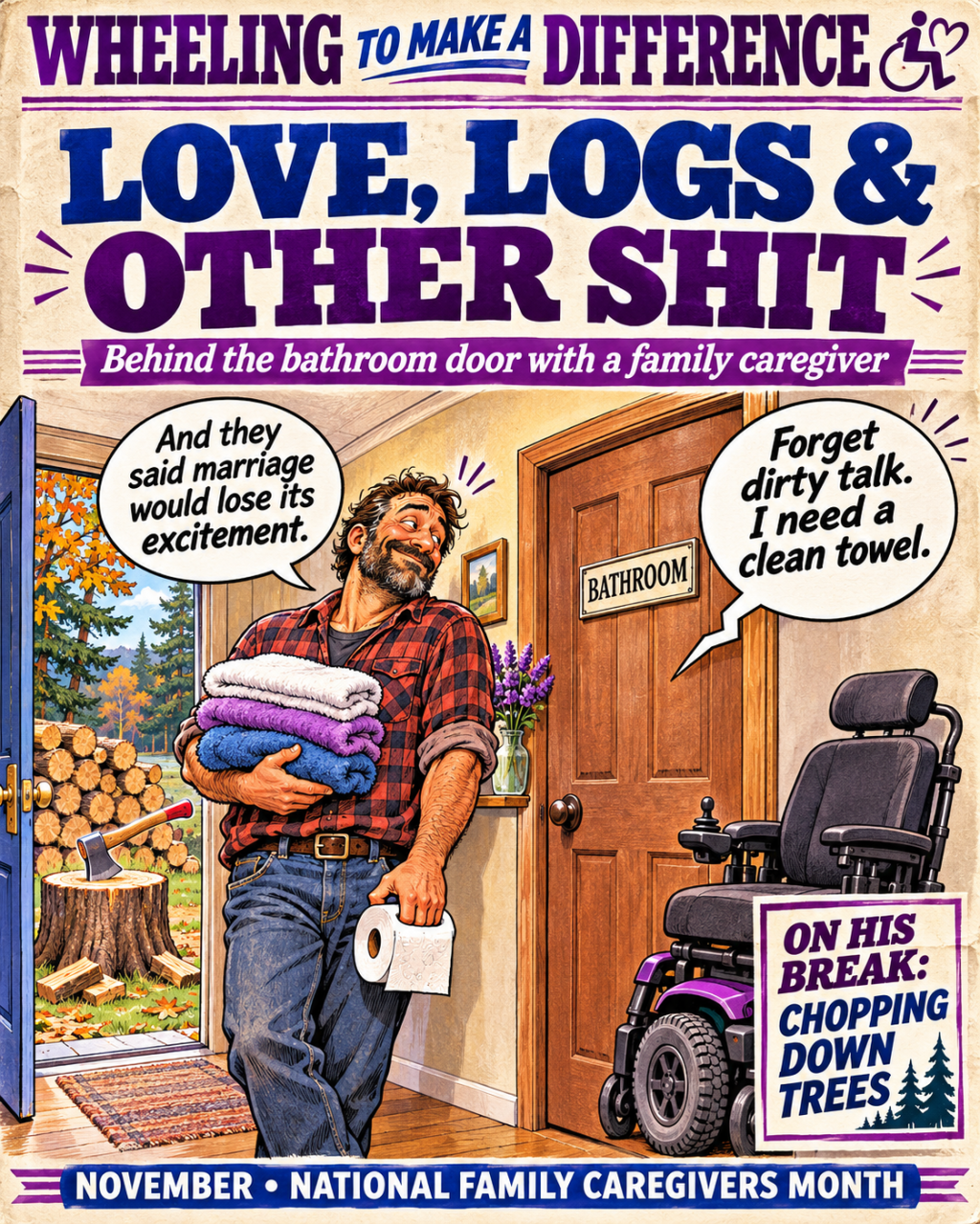
Behind the Bathroom Door: The Unseen Work of Family Caregivers
For National Family Caregivers Month: I missed voting because my bowel routine failed. My husband spent the day helping me back and forth to the bathroom—and keeping our household running in between.
On Election Day, I wanted to cast a ballot. Instead, my husband and I spent the day negotiating with my bowels.
My suppository didn’t work as expected. My stomach was a mess. I had an accident, and the polling location was far enough away that I couldn’t count on getting there, voting, and making it home without another one.
As far as reasons not to vote, I guess this is a pretty good one.
I can already feel the hesitation that comes with writing that sentence. There are things you’re supposed to keep private, especially as a woman, especially on the internet, where everyone is apparently maintaining a spotless house and a highly cooperative digestive system.
But “I wasn’t feeling well” leaves too much out.
It leaves out why I couldn’t go. It leaves out the distance. And it leaves out my husband, Brad, who spent the day taking me back and forth to the bathroom.
November is National Family Caregivers Month.
This seems like a reasonable time to talk about what that actually looks like.
Behind the bathroom door
As someone living with quadriplegia, I need help with things most adults do privately and without much thought. When my bowel routine doesn’t go as planned, I can’t simply handle it and carry on.
I need assistance. Then I may need it again. And again.
There is no tidy appointment window for this. No convenient notification telling us the situation will resolve in twenty minutes. We have to keep responding to what my body is doing, even when we had other plans.
That day, Brad kept helping me to the bathroom and back.
In between, he worked around the house and cut down trees.
Apparently, our version of a caregiver break involves lumberjack duty.
From outside, someone might have seen a man doing yardwork. They wouldn’t have known how many times he stopped to help his wife, or how much care was happening between those ordinary household tasks.
I saw it.
That is part of why I’m sharing this. I want his work to be visible without either of us having to pretend it was an easy day.
The rest of life stays on the calendar
Taking care of me doesn’t make the house stop needing attention. The yard doesn’t maintain itself. Household responsibilities don’t disappear because we’ve already spent hours dealing with something exhausting.
Brad kept fitting those responsibilities into the stretches when I didn’t need his help.
When people hear “family caregiver,” they may picture someone picking up a prescription or bringing a meal. Those things matter. But caregiving can also mean helping your spouse with toileting throughout the day while trying to get everything else done.
It means being needed again after you thought you were finished.
And being the person receiving that care means knowing how much help you need, even when you desperately wish you could give both of you a break.
There can be love, gratitude, frustration, exhaustion, and embarrassment in the same afternoon. Marriage has to make room for all of it.
The wedding vows tend to summarize this part. “In sickness and in health” is considerably shorter than the actual job description.
The vote I couldn’t cast
In the middle of all this, I wanted to vote.
I had opinions. I had concerns. I wanted a say in decisions that affect our lives.
But getting to my polling location involved more than deciding when to leave. I had to consider the drive, the wait, the time inside, and the trip home. I had to consider what would happen if I needed immediate bathroom help along the way.
Where could we stop? Would there be enough room for Brad to assist me? Could we manage an accident with privacy and dignity? How long would we be away from the place where we had what we needed?
The distance mattered because it meant more time away from home while my body was unpredictable.
An accessible entrance wouldn’t have answered all those questions.
This is part of what I mean when I talk about accessibility: the whole experience of getting somewhere, participating, and returning home. On paper, an outing can look possible. Inside a particular body, on a particular day, it can become impossible.
So I stayed home.
I won’t speak for Brad’s voting experience. I can say that much of his day went toward helping me get through mine.
And I missed something that mattered to me.
Meanwhile, families wait for help
Applying for assistance doesn’t immediately put another person in your home.
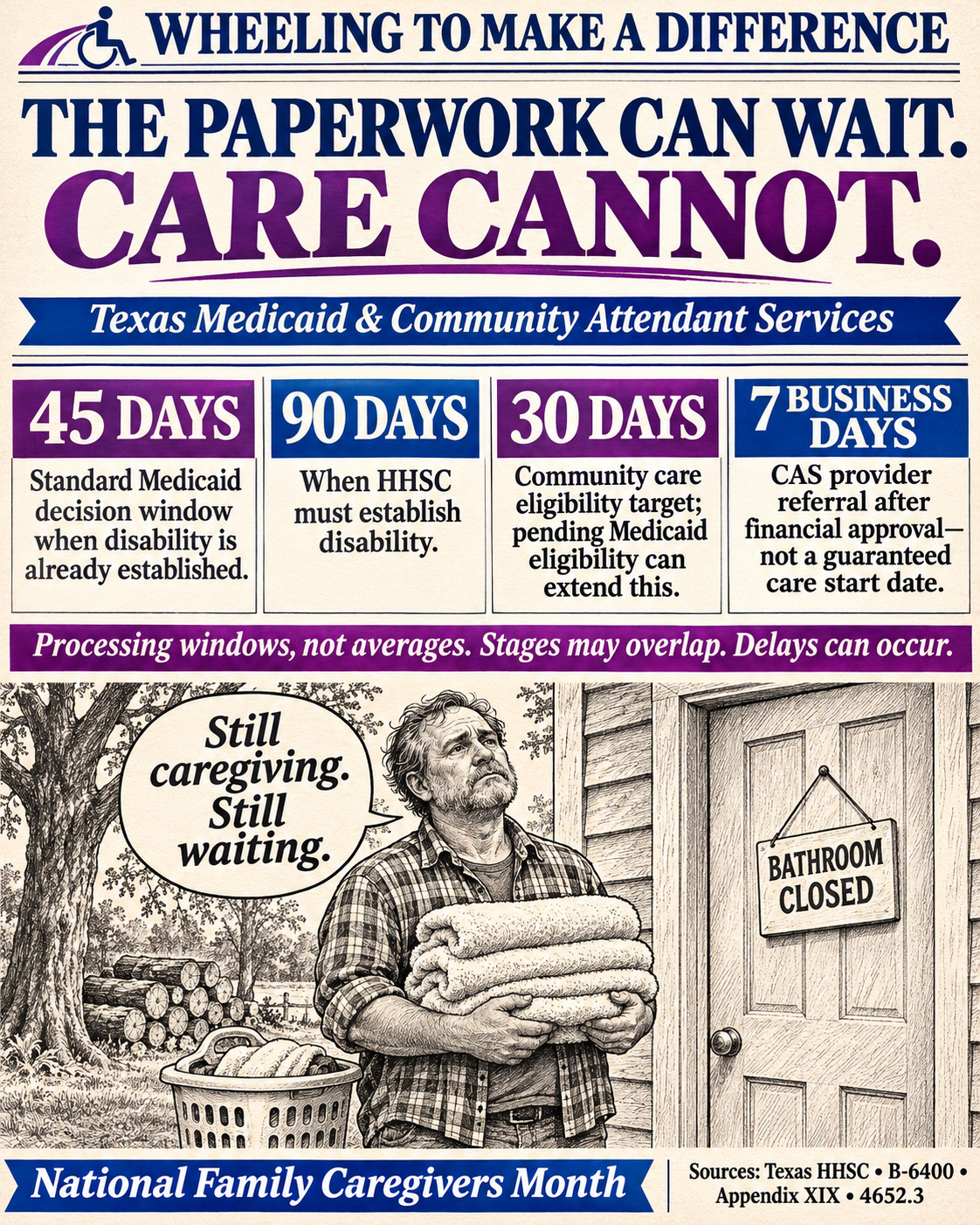
In Texas, the standard Medicaid eligibility decision window is generally 45 days when disability is already established, or 90 days when HHSC must establish disability. Those are processing deadlines, not verified averages or guarantees that a caregiver will arrive by then. Source: Texas HHSC processing deadlines.
Community care eligibility normally has a 30-day timeframe, but Community Attendant Services applications can take longer while Medicaid financial eligibility is pending. After financial approval, the CAS caseworker has seven business days to enter assessment information and send the provider referral packet. That referral is another step toward care, rather than a guaranteed start date. These stages can overlap; they should not simply be added together. Source: HHSC case management timeframes and CAS referral policy.
On an administrative calendar, those are processing windows.
Inside a home, they are days of bathroom trips, transfers, household work, and figuring out who can help.
My body doesn’t stop needing care while an application is pending. Brad’s other responsibilities don’t pause either. Every day spent waiting is another day we have to make it work with the help we have.
Texas does have a potential bridge: a Family Care referral while CAS financial eligibility is pending. State policy requires that referral in certain immediate or expedited situations, unless the region is placing new applicants on an interest list. That is something families can ask their caseworker about, though it does not guarantee immediate help. Source: HHSC, section 4652.4.
Knowing which question to ask becomes one more task.
Somewhere between the bathroom and the trees, we’re also supposed to navigate the paperwork.
Appreciation needs something behind it
I am grateful for my husband.
I also want him to have time that belongs to him. Time to rest. Time to finish something without interruption. Time when he doesn’t have to wonder whether I’ll need help before he gets through the next task.
I want reliable assistance so that our marriage has more room for simply being married.
And I want to leave my house, participate in my community, and make plans without every outing depending on whether the two of us can manage every possible care need alone.
Those wishes belong together.
For National Family Caregivers Month, appreciation should include an honest look at what families are doing and what would make their days more manageable. Reliable help. Respite. Services they can reach. Clear answers about when support might actually begin.
Calling someone devoted doesn’t give them an afternoon off.
The amount I’m choosing to share
I don’t owe the internet every intimate detail of my life. Neither does Brad.
But I’m willing to share this much: my bowel routine failed, I needed repeated help, and my husband provided it. In between, he kept working around the house and cutting down trees. I couldn’t safely manage the trip to vote.
That was one day in our home.
There was care in it. There was work in it. There was disappointment, and there was the kind of absurdity you sometimes have to laugh at because you are already living it.
I wanted to cast a ballot. Brad wanted to get things done. My bowels apparently had their own agenda.
So this November, remember the caregivers behind closed bathroom doors—and the people they’re helping, who also had somewhere they wanted to be.
And if you’re wondering what to give a family caregiver for their appreciation month, an actual break is a good place to start.
Preferably one that doesn’t require a chainsaw.


Leave a Reply