
The physical cost of our clicks, searches, saved files, and digital leftovers.
We create real problems through a world that feels almost imaginary.
A photograph disappears into the cloud. A search takes a fraction of a second. We save a post, share a video, and move on. Nothing seems heavier. No new box appears in the living room.
But somewhere, hardware holds those files and records. Electricity powers it. Cooling systems manage its heat. Materials were extracted or recovered to build the devices on both ends of the connection.
We call this a virtual world. Its demands on the physical world are real.
Nothing seems heavier when we hit save. Somewhere else, the weight adds up.
The cloud has a utility bill
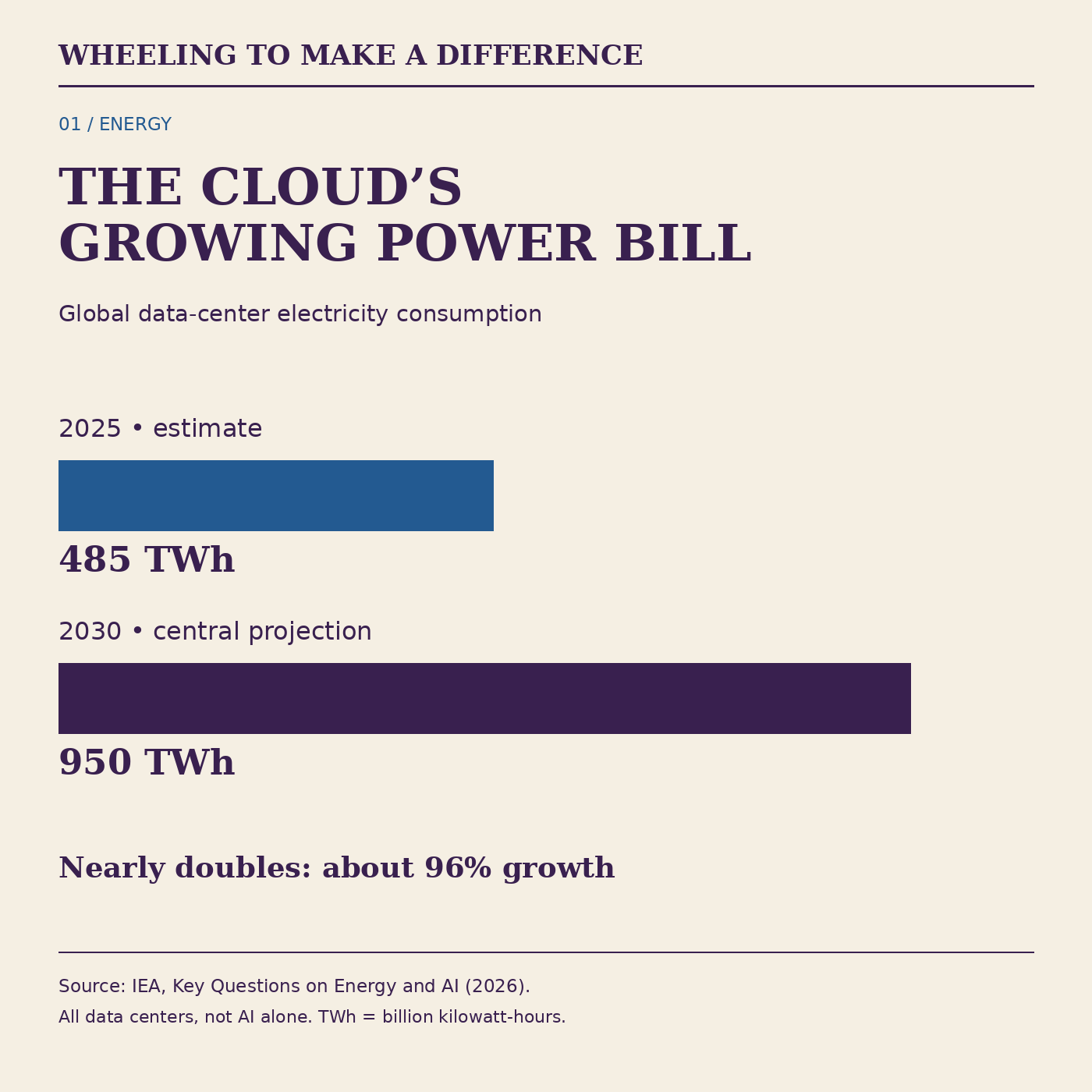
The International Energy Agency estimates that data centers worldwide used 485 terawatt-hours of electricity in 2025—485 billion kilowatt-hours. Its central projection puts demand at roughly 950 terawatt-hours by 2030, nearly double. These figures cover data centers overall, not just personal storage or AI.
Water adds another layer. Facilities can consume water directly for cooling and indirectly through electricity generation. The consequences depend on the cooling system, the energy supply, and local water conditions. Research from Lawrence Berkeley National Laboratory shows why location matters: this infrastructure can place demands on watersheds already experiencing water stress.

Those totals cannot honestly be divided into one universal environmental price per click. Storing a file, streaming video, and processing speech do different work. Electricity use is also not the same as carbon emissions: how the electricity is generated matters.
But “too complicated to assign precisely to me” does not mean “no environmental cost.”
How much physical space does one digital life occupy?
I started with a smaller question: how much room do my clicks, searches, and saved files actually take up? The answer helps make the infrastructure visible, even though storage volume alone cannot tell us its environmental toll.
First, what are we counting?
Saving a post as a bookmark can mean storing a reference to something that already exists. Uploading a video means storing the video itself. Sharing a link and uploading a fresh copy are therefore very different storage events.
Then there are activity records: entries describing a search, page view, click, or other interaction.
There is no honest rule that says “one click equals this many bytes” across the entire internet. But we can build a transparent example.
A year of digital breadcrumbs
Imagine one person generates 1,000 recorded activity events per day, and each stored event averages 1 kilobyte.
These are assumptions, not measured averages. An event is not necessarily one deliberate click: an application can record other activity, too.
| Time | Activity records | Data before extra copies or overhead |
|---|---|---|
| One day | 1,000 | 1 MB |
| One year | 365,000 | 365 MB |
| Ten years | 3.65 million | 3.65 GB |
The ten-year number assumes everything is retained. Actual systems may delete, summarize, or compress older records.
If each record averaged 5 KB instead, the annual total would be 1.825 GB. The size of the record matters as much as the number of actions.
All calculations here use decimal units: 1 KB = 1,000 bytes.
What about my search history?
This deserves more attention than a passing mention under “clicks.”
A saved search can contain more than the words typed into a box. Google’s documentation, for example, describes saved activity that can include searches, associated information such as location and device details, and—in certain settings—Chrome history and activity from sites using Google services. What is retained depends on the service and settings.[1]
For our accounting, possible categories include:
| Information | What we would need to count |
|---|---|
| Search history | Query text, date, time, and account or session identifiers |
| Associated activity | Records of results clicked and subsequent actions |
| Context | Stored device, browser, language, or location information |
| Derived profile | Any retained interests or categories inferred from activity |
| Storage overhead | Indexes used to retrieve records, backups, and redundant copies |
This is an accounting checklist, not a claim that every company stores every item for every search. A profile may be maintained separately rather than copied into each record.
Suppose someone makes 20 searches a day. If each saved search record, including its associated metadata, averages 1–5 KB, the calculation looks like this:
| Retention period | Searches | Illustrative storage |
|---|---|---|
| One year | 7,300 | 7.3–36.5 MB |
| Ten years | 73,000 | 73–365 MB |
| Ten years with three full copies | 73,000 unique searches | 219 MB–1.095 GB |
Again, these sizes are assumptions—not industry averages. They count records about searches, not copies of every webpage visited, and exclude separately maintained profiles and database overhead.
If those searches already fall within our earlier 1,000 daily activity events, we do not add them twice.
The distinction matters: my photo collection is something I know I am keeping. The record of what I wondered about at two in the morning is a different kind of collection.
Somewhere, a machine is keeping something I have already forgotten.
Now give those bytes a physical address
As a concrete reference, Seagate’s 24-terabyte Exos X24 drive measures approximately 147 × 101.85 × 26.1 millimeters: an exterior volume of about 391 cubic centimeters.[2]
Dividing that volume proportionally by its advertised capacity gives us an illustrative share of the hardware.
| Stored data | Proportional drive volume |
|---|---|
| 365 MB: our hypothetical year of activity | About 6 mm³ |
| 3.65 GB: ten years of that activity | About 60 mm³ |
| 100 GB of files | About 1.63 cm³ |
| 1 TB of files | About 16.3 cm³ |
Our hypothetical year of activity corresponds to roughly the volume of a cube less than two millimeters wide.
That does not mean someone could open the drive and extract a tiny cube labeled with my name. This is a proportional allocation of shared hardware at full advertised capacity. It excludes servers, racks, wiring, spare capacity, cooling, and the building.
For the separate ten-year search-history example, 73–365 MB would correspond to about 1.2–6 cubic millimeters of that drive before extra copies.
Physically tiny. Potentially very revealing.
The photos change the calculation
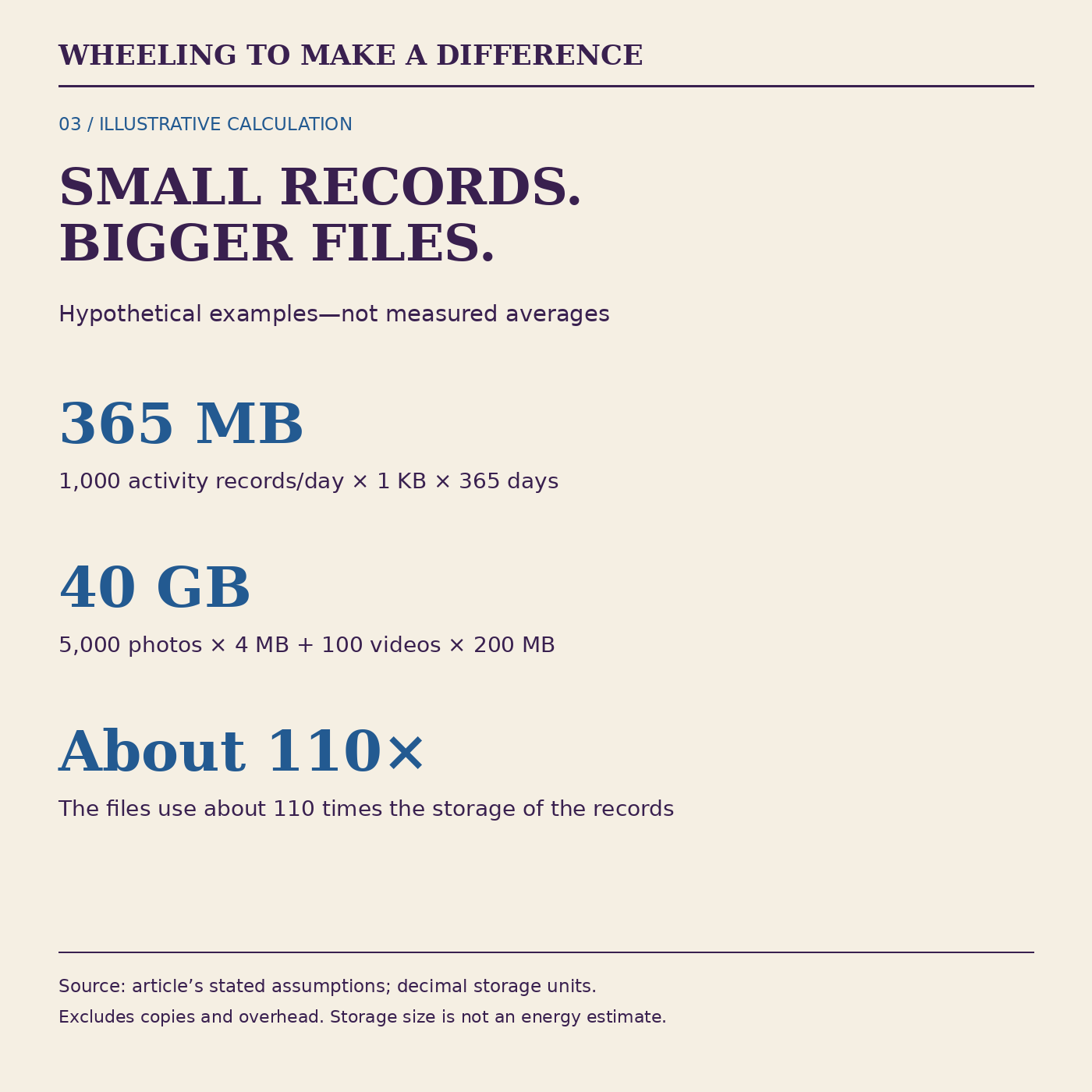
Suppose I upload 5,000 photographs averaging 4 MB each. That is 20 GB.
Suppose I also store 100 videos averaging 200 MB each. That adds another 20 GB.
Those hypothetical files total 40 GB—about 110 times the storage of our year of activity records.
What I upload can outweigh the record of what I click. But byte count is not a measure of intimacy. A short list of searches can say more about my worries than a large photograph of my dinner.
The photograph is of a place we love. Keeping it forever still asks something of the planet.
Even getting these words onto the page creates data
And then there is the way I am writing this.
I use voice-to-text. Before these words become sentences on a screen, they exist as audio that a device has to process. Depending on the technology and settings, that processing may happen on my phone or involve a server somewhere else. Apple, for example, supports on-device dictation, so spoken words do not automatically become a permanent recording in a data center.[4]
Still, we can quantify a hypothetical audio stream. At an assumed encoding rate of 64 kilobits per second, it produces:
| Amount of dictation | Audio data generated at the assumed rate |
|---|---|
| One minute | 0.48 MB |
| Thirty minutes | 14.4 MB |
| Thirty minutes daily for a year | 5.26 GB |
That annual figure becomes a storage footprint only if the audio is retained. It is not a measurement of my usage or my phone’s audio format. Processing data, transmitting data, and keeping data are different things.
If all that hypothetical audio were retained, it would represent about 0.086 cubic centimeters of our example drive before extra copies. The resulting text would be another item to count wherever it is saved—but only once if it is already included among our documents or messages.
Voice-to-text also illustrates why processing, transmission, and long-term storage need separate accounting. A useful digital service can have a physical cost without every interaction becoming a permanent recording.
And I may not live in just one data center
Cloud storage can spread data across multiple locations for resilience. Amazon S3 documents several storage classes that store data redundantly across at least three Availability Zones. That does not establish an exact three-copy multiplier for every service or person.[3]
For our own illustration, if we assume three full copies, 40 GB becomes 120 GB across those copies. Its proportional drive volume becomes about 1.96 cubic centimeters.
That still does not tell us our share of an entire facility—or the electricity and water associated with serving our requests. Storage volume alone cannot answer those questions.
So how much room do I actually take up?
For the hypothetical person in this article, 40 GB of photos and videos plus one year of activity records at 365 MB would total 40.365 GB before copies and overhead. Search records are included in those activity records, not added again.
On our example drive, that represents about 0.66 cubic centimeters of proportional hardware volume—or about 1.97 cubic centimeters under our three-copy assumption.
If we additionally retained our hypothetical year of dictation audio, the total would rise to about 45.62 GB, or about 0.74 cubic centimeters of proportional drive volume before extra copies. We cannot add that audio to the actual total unless we know it was saved.
That is a worked example, not an estimate of the average person’s complete digital footprint. A fuller accounting would also need email, messages, documents, other services’ retained records, and any separately stored profiles, without counting the same data twice.
My digital presence can be physically small while depending on an enormous shared system.
My clicks have a place. My photographs have a place. Even the things I saved and forgot about have a place, for as long as somebody keeps them.
And somewhere in that accounting are the things I never consciously decided to save at all.
How much physical space does it take to store the things I remember—and the things companies choose to remember about me?
The screen goes dark. The hardware stays.
The footprint begins before anything reaches a data center.
The phone on my wheelchair mount, the laptop on someone’s desk, and the servers behind our apps all have to be manufactured. Materials must be extracted or recovered, refined, made into components, assembled, and transported. Charging a device is only part of its life.
Apple’s product environmental reporting, for example, accounts for materials, manufacturing electricity, transportation, charging, and end-of-life processing. A device with recycled content still has a physical supply chain and a manufacturing footprint.

Then comes the question of where the hardware goes when we are finished with it.
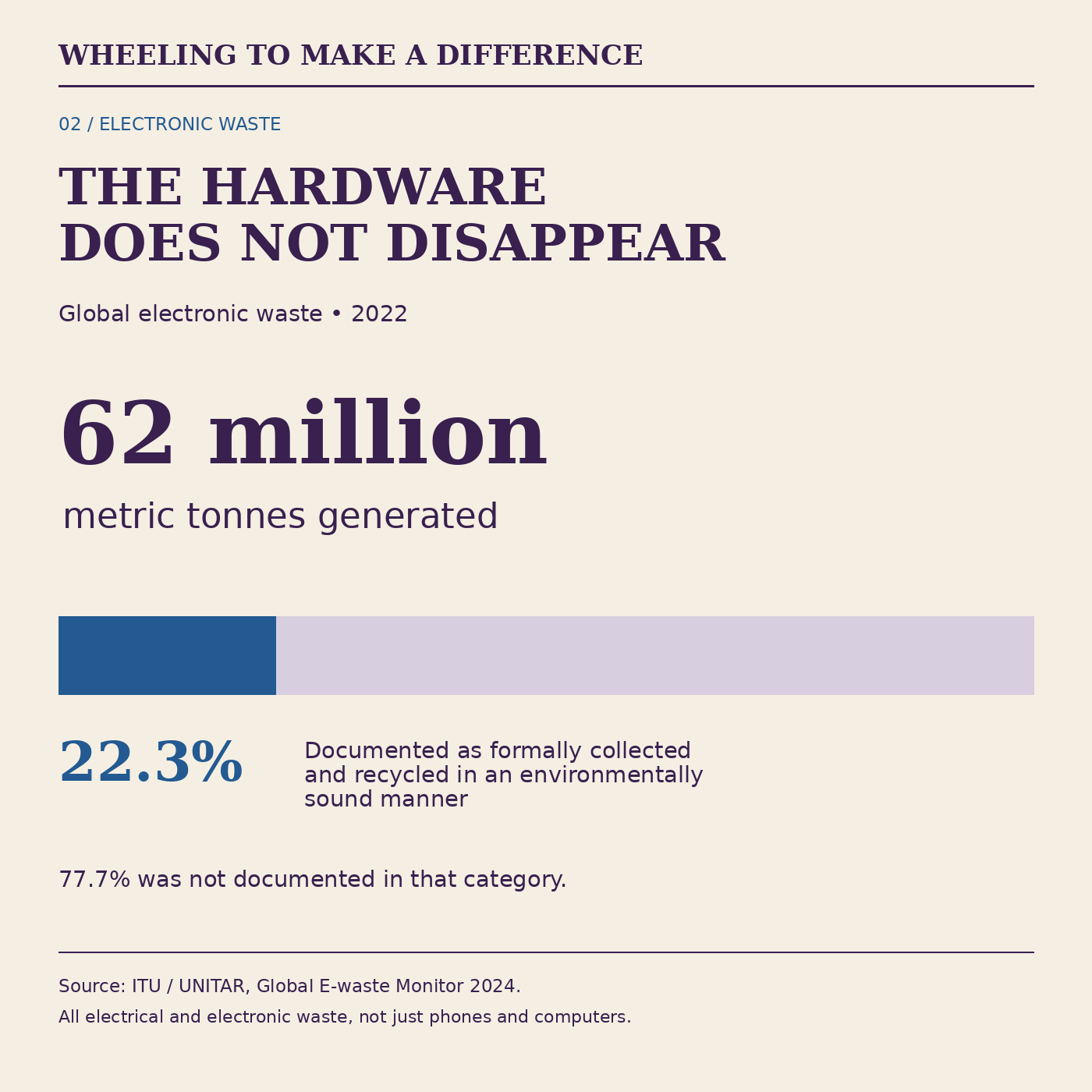
According to the United Nations’ Global E-waste Monitor 2024, the world generated 62 million metric tonnes of electronic waste in 2022. Only 22.3% was documented as formally collected and recycled in an environmentally sound manner. This total includes a broad range of electrical and electronic equipment, not just phones and computers.
Deleting a photograph does not make a server disappear. Replacing a phone does not make the old one stop existing.
The screen goes dark. The hardware stays.
What are we choosing to keep?
I started by wondering how much room my digital life takes up. I ended up wondering how much of the world we are willing to use to keep everything.
There is plenty here worth keeping. Family photographs. Useful research. The tools that let us work, communicate, and create. I am writing this with voice-to-text; I know what this technology makes possible.
But knowing what sits behind the screen gives us a reason to be more deliberate. Maybe a working phone gets another year. Maybe the old laptop finally goes somewhere it can be reused or responsibly recycled. Maybe we take a look at what our accounts save automatically.
The larger decisions deserve that same attention. When a company promises a greener device, how long will it support repairs and software updates? When a data center comes to town, where will its electricity and water come from, and what will that mean for the people already living there?
Those seem like reasonable questions to ask in exchange for the land, resources, and trust these systems require.
I would like to see technology that lasts longer, companies that explain what they keep and why, and environmental costs that are as easy to find as the price of another storage upgrade.
We can appreciate the convenience and still ask for something better.
The cloud has a material life before our data arrives and after we have forgotten what we saved. Paying attention to that is a place to start.
We built a virtual world. We can be more thoughtful about what it asks of the real one.
Sources for the storage calculations
[1] Google: Web & App Activity
[2] Seagate Exos X24 specifications


Leave a Reply