
Taxes will help pay for parks and libraries. Residents deserve to know where the money goes—and whether everyone will be able to use what it buys.
By Danielle Tyler | Wheeling to Make a Difference ATX
Opinion | November 13, 2026

A library can be open to the public. Its books can take you halfway across the world. But it can still be impossible to enter.
A playground can welcome families while leaving a parent in a wheelchair watching from the edge.
Sometimes, one curb, one dirt road, one heavy door is all it takes to leave someone out.
Austin voters recently approved $295 million in bonds. That is money the city borrows and repays with property taxes. Of that total, $260 million is for parks and recreation, and $35 million is for libraries. The library plans include work at the Hampton Branch at Oak Hill and planning and design for a future Colony Park branch. [1][2]
KUT reported that the bond package could add about $40 a year to the property-tax bill for a home valued at $495,000. That is an estimate, not a flat charge for every home. It also does not include every other change to a household’s tax bill. [3]
Forty dollars may sound small when City Hall is talking about millions. Families, however, have other bills. We cannot issue bonds when the grocery budget runs short.
So it is fair to ask: What are we getting for the money?
Even a city that wants to keep things weird should be able to explain its spending clearly.
As a wheelchair user and a mother, I want to enjoy these places with my family. Can I reach the playground? Can I get through the library entrance? Is there a restroom I can use?
These details decide whether I can join in or have to watch.
Austin’s parks plans do include accessibility work. A September presentation lists improvements under the Americans with Disabilities Act, or ADA, along with safety work in a $65.5 million fund for buildings, recreation facilities and senior centers. It also names an Onion Creek all-abilities playground among possible projects in a $29.5 million fund for park features and repairs. [4]
But those amounts cover many kinds of work. They are not set aside only for accessibility. The presentation does not say how much of that money will go toward removing barriers for disabled people.
Which problems will be fixed? Where? And when?
Before we applaud the number of zeros, it would be nice to see the itemized receipt.
The library summaries reviewed for this article do not give a separate accessibility budget or a detailed list of access improvements either. That does not mean those needs were ignored. It means we still need more information.
We also need to know who is drawing up the plans.
Who makes the choices: city staff, outside designers or someone else? When do disabled residents get to review them? Can they still change anything by then?
Different people will notice different problems. A wheelchair user may spot a doorway that is hard to reach. A blind person may need clearer ways to find the entrance. Someone who gets tired easily may need benches along a long path. Someone with a sensory disability may notice problems with noise or lighting.
One person cannot speak for every disability.
Austin did ask for public input while putting the bond package together. Its website lists surveys and public meetings, including online options. A 22-member group chosen by the mayor and City Council also helped review funding needs. [5]
So it would be wrong to say the public had no chance to comment.
But helping choose which projects get money is different from helping design them. Residents need to know how that next step will work.
A committee can have 22 seats and still need to ask who can actually get to the table.
The city should explain who is in charge of each project and which decisions are still open. It should share drawings with plain-language descriptions. It should tell people when comments are due and how to request help or accommodations so they can take part.
And people need to hear about those chances before they are over.
Where will notices be posted? How early? Will they reach people who do not spend their free time reading council agendas?
With yet another increase headed for the tax bill, perhaps clearer public notices could be included at no extra charge.
Going to a meeting is not simple for everyone. Some people need a caregiver, a ride or time away from medical care. Others cannot leave home easily.
Online meetings and written comments should give those residents a real say. Their voices should count even when they cannot show up in person.
Then the city needs to show what happened to those comments.
What did residents ask for? What changed because they spoke up? If an idea was turned down, why?
Not every request can be approved. Money, safety and design limits can affect a decision. But residents deserve an explanation they can understand.
Counting comments is easy. Showing that they mattered takes more work.
Roadwork brings up some of the same questions.
For wheelchair users, potholes are more than an inconvenience. A hard hit can damage a chair, sometimes beyond repair. My power wheelchair is worth more than my car, and I have to plan around a five-year insurance replacement cycle. I cannot treat that risk as just another bump in the road. My independence rides on those wheels.
This bond package is for parks and libraries. The parks plan includes work on roads, parking lots and trails, but it is not a general plan to pave neighborhood roads. [4]
For public roads in general, the type of work matters under federal accessibility rules. Resurfacing or rebuilding a road can require curb ramps where walkways cross curbs. Basic repairs, such as filling potholes, usually do not trigger those same rules. These rules do not require every dirt road to be paved or a new sidewalk to be built with every road repair. [6]
Residents should be able to ask what work is planned, which rules apply and how access for disabled people was checked. Federal guidance also warns against planning resurfacing work in a way that avoids curb-ramp requirements. [7]
My work on Sutton Drive makes these questions personal. But that road’s funding and the agency responsible for it must be looked at separately. Austin’s bond approval does not mean Sutton Drive has been funded.
The city says it expects to post more details about bond projects and spending on its online dashboard in early 2027. [1]
That information should tell residents which access problems will be fixed, what work is planned and when it should be done. It should also explain how people can help shape the designs.
And access needs to last beyond opening day. Families should know who to contact when a feature is broken and how repairs will be handled.
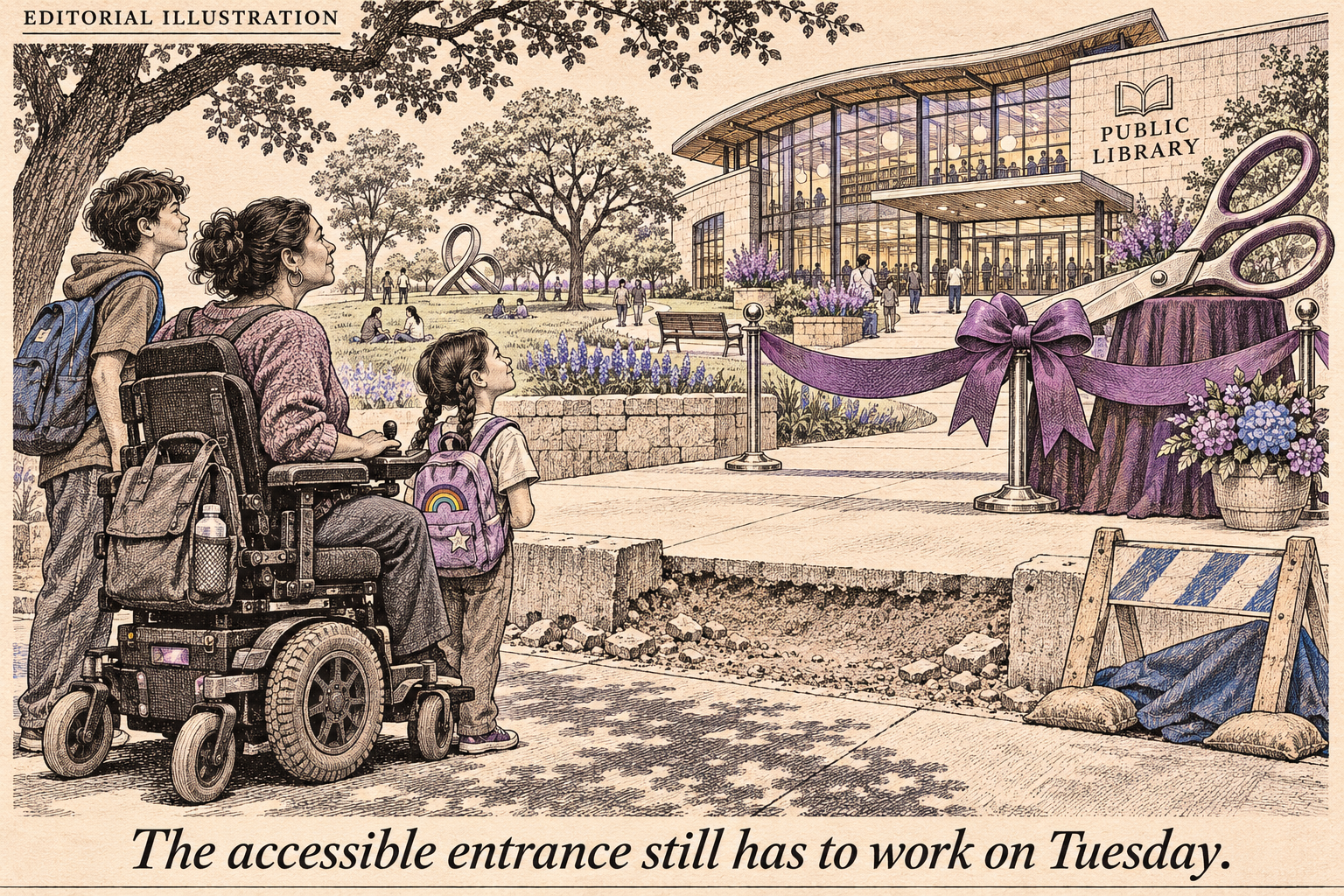
The ribbon-cutting scissors can go back in the drawer. The accessible entrance still has to work on Tuesday.
Parks and libraries are worth investing in. They give families places to learn, play and spend time together.
Asking where the money goes and who gets a voice helps make those places better.
A parent should be able to join a child at the park. Austin has approved the money. Now residents deserve a clear say in what it builds—and a fair chance to use it.
Sources
1. City of Austin, November 4, 2026: Austin Voters Approve $295 Million Bond Package.
2. City Council: Bond-election item, File 26-2115.
3. KUT, October 15, 2026: Austin voters to weigh in on $295 million bond package for parks, libraries.
4. Austin Parks and Recreation, September 28, 2026: Parks Bond Development, slide 8.
5. City of Austin: 2026 Bond Development.
6. U.S. Departments of Justice and Transportation: Joint technical assistance on road resurfacing and curb ramps.
7. U.S. Departments of Justice and Transportation: Supplemental questions and answers.


Leave a Reply