Opinion | November 15, 2026
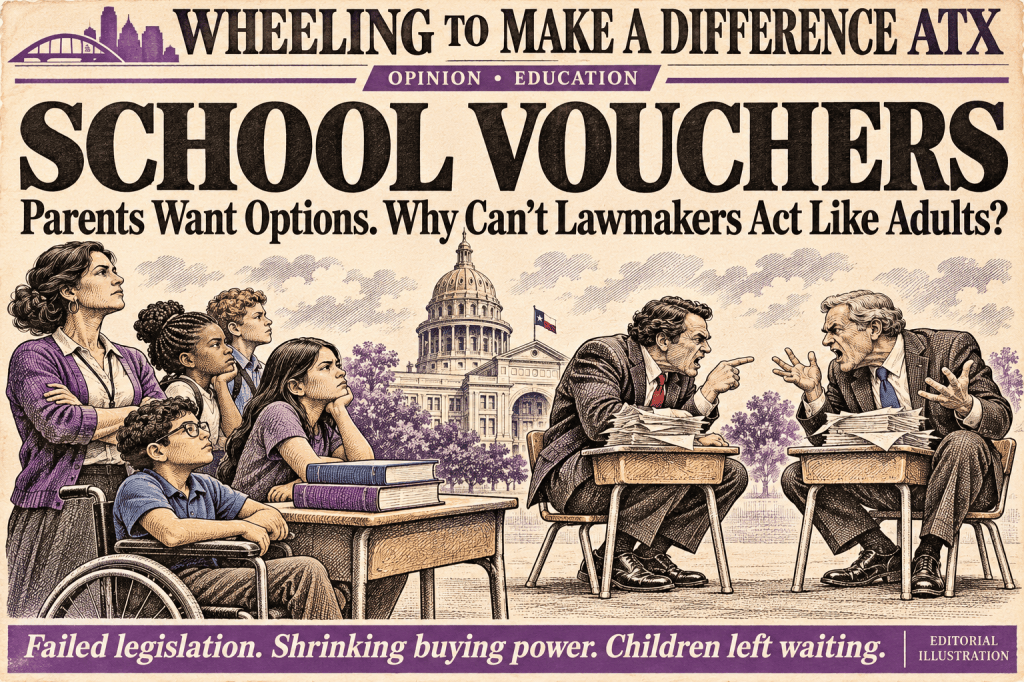
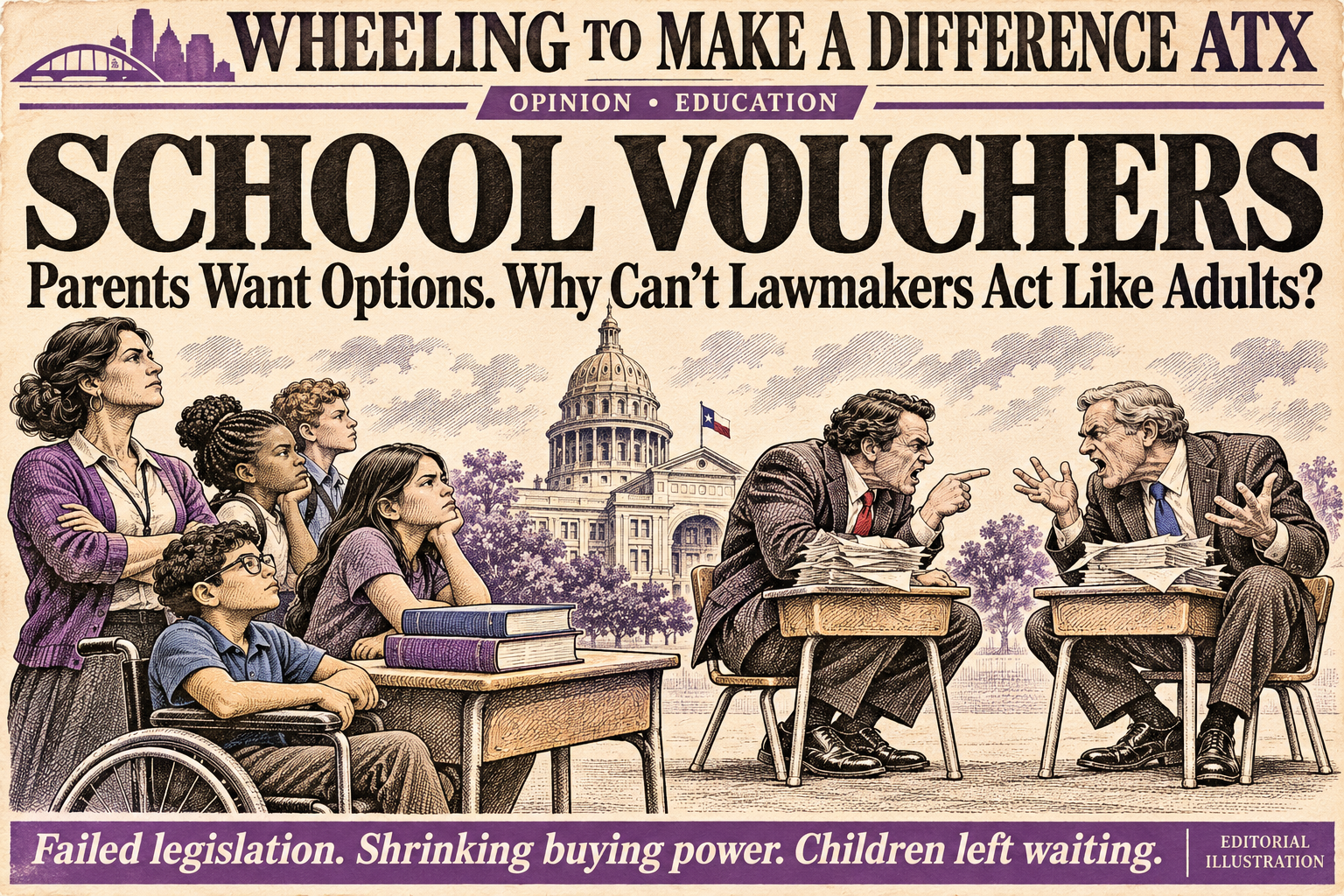
A parent whose child cries before school does not have the luxury of waiting for the next legislative session.
For families raising children with disabilities, finding the right school can begin with basic questions: Can my child safely use the classroom and restroom? Is transportation accessible? Will communication needs, sensory needs and learning supports be taken seriously? Parents should be able to expect both an accessible building and a school day their child can fully participate in.
Whether the problem is bullying, unmet disability needs, academic struggles or a classroom that simply is not the right fit, that parent wants a workable alternative. That is understandable. A child gets one childhood, and asking a family to sacrifice it while adults debate education policy is a difficult argument to defend.
But another question deserves equal urgency: Why should finding a good education require leaving the public school system in the first place?
I understand the desire for school choice. But the larger story is what happened before a family started looking for an exit: funding decisions, failed legislation and political fights that leave schools trying to meet rising needs with uncertain resources. Parents deserve options. They also deserve a government willing to make their neighborhood school a good one.
The voucher debate too often turns parents and teachers into opposing teams. Meanwhile, the people responsible for funding the system get to stand at the microphone and explain why everyone else needs to do better.
Somewhere along the way, the adults arguing about education seem to have misplaced the kindergarten lesson on working together. Take turns. Listen. Solve the problem. Apparently, these expectations become optional once you have a campaign account.
Republicans should be able to defend parental choice while admitting that public schools need dependable resources. Democrats should be able to defend public education while admitting that some families need another option right now. Neither acknowledgment should require a formal apology to the party.
When school funding becomes a bargaining chip
Before asking parents to choose a different school, we should ask what lawmakers have chosen for the schools those children already attend.
In 2023, Texas House Bill 100 offered an opportunity to increase school funding and teacher pay. The House version proposed roughly $4.5 billion in additional funding. The Senate added an education savings account program, and negotiations collapsed. The bill died; the proposed funding and raises died with it. [16]
That was a legislative failure with consequences beyond the Capitol. A proposal cannot pay a teacher. A negotiating position cannot keep a counselor on campus. Children still arrive on Monday, whether the adults reached an agreement or decided to issue competing statements about whose fault it was.
The political history matters. House Democrats and rural Republicans joined together against vouchers. This was not simply two parties refusing to speak. It was also a fight within the Republican Party over whether public-school funding should be tied to private-school choice. [16]
Calling for cooperation should not mean inventing equal responsibility. The officials who attach conditions to funding should answer for those conditions. Lawmakers who reject a proposal should explain the alternative they will actually work to pass. And leaders with the votes and authority to shape the agenda bear a different responsibility from those without them.
My objection is to making children’s basic educational resources contingent on winning a separate ideological argument. Debate vouchers on their merits. Debate school funding on what schools need. Families should not have to wait for one side to surrender before their child’s classroom gets help.
We would not accept “I refused to finish the assignment because he would not agree with me” from a fourth grader. Apparently, the same explanation sounds more distinguished behind a legislative seal.
How schools lose funding without a headline announcing a cut
“Defunding” can describe several different things. Some are direct budget cuts. Others are decisions that leave schools with less purchasing power or less dependable support. Understanding the difference makes it harder for officials to hide behind a large dollar figure.
First, lawmakers can cut the money outright. Texas approved $5.4 billion in education cuts in 2011. Later reporting documented continuing staffing and classroom consequences. Restoring money afterward cannot return the school years children spent without those resources. [5]
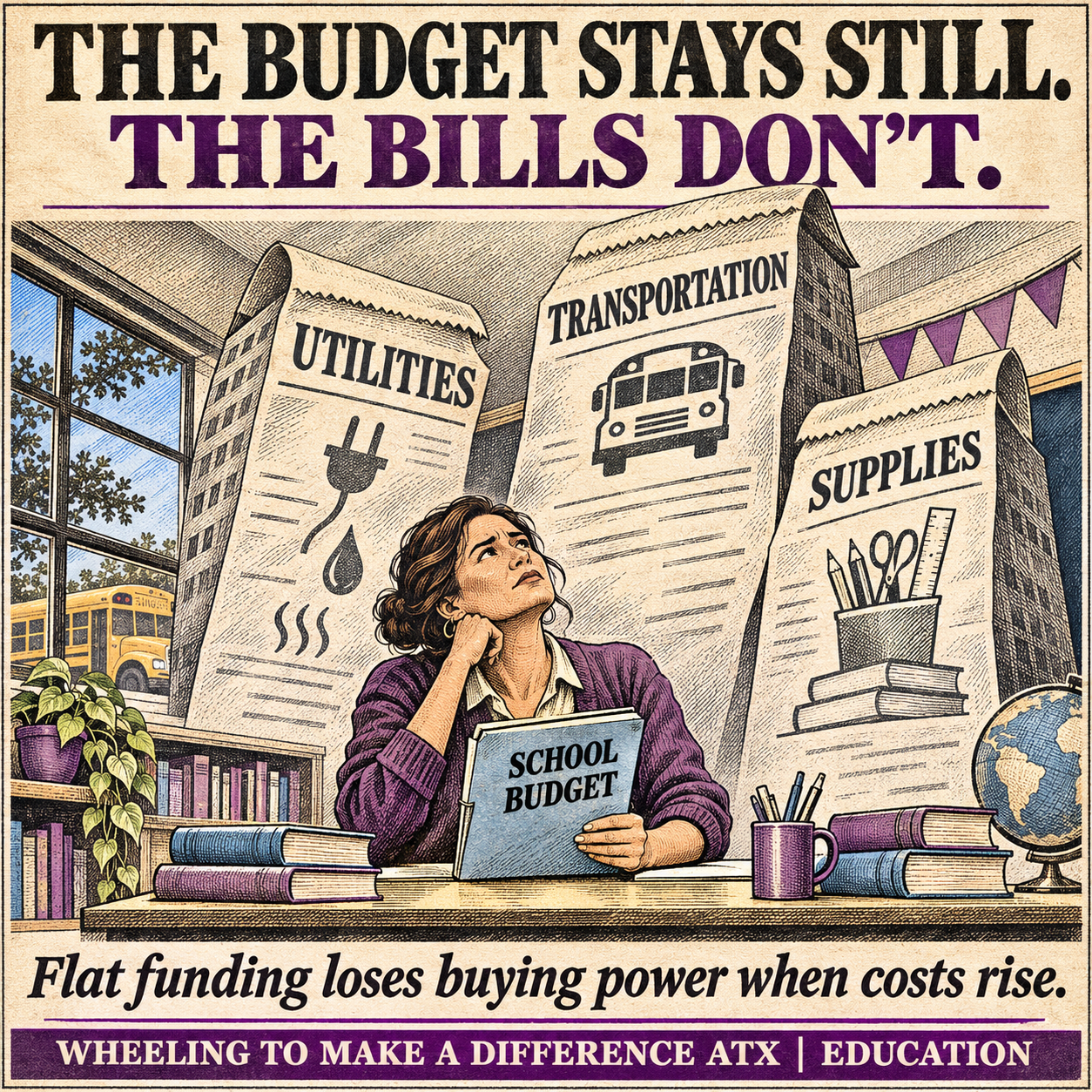
Second, lawmakers can freeze the funding formula while costs keep rising. Texas’s basic allotment remained at $6,160 from 2019 until the 2025 changes. It is a starting point in the formula, not the state’s entire spending per child. But leaving that starting point unchanged through years of inflation erodes what it can buy. [8][17]
Consider a hypothetical school budget of $100. If the same services now cost $120, keeping the budget at $100 leaves a $20 gap. Nobody has to announce a cut for the school to face a real shortfall. Someone must reduce services, find another source of money or absorb the cost. This illustration is not a claim that every Texas school experienced precisely 20 percent inflation.
Third, a larger state education budget can replace other money rather than add classroom resources. Property-tax relief is a useful example. When the state replaces local revenue lost through tax-rate compression, the state contribution rises. TEA explains that Tier One compression changes the state-local funding balance without changing a district’s total entitlement under that part of the formula. Tax relief and additional classroom funding are different accomplishments. [18]
A homeowner can receive relief without the school gaining money for another teacher. Both may be worthwhile policies; they should not be advertised as the same purchase.
Fourth, temporary assistance can make recurring funding look healthier than it is. Federal pandemic aid helped schools, but it was temporary. Counting it in a banner spending figure does not establish that districts can maintain the services it supported. A 2025 Texas Tribune analysis found that claims about record per-student funding obscured inflation and largely expired federal relief. [17]
Fifth, money can arrive with limits on its use. Targeted funding can protect important priorities, including compensation and student services. But a dollar assigned to one purpose is not necessarily available for another expense. Texas’s 2025 funding changes included separate allotments for basic costs, safety and other needs. Evaluating that package requires looking at what each allocation covers, not treating every dollar as interchangeable. [8]
These mechanisms are not all identical, and not every shortfall proves an intentional effort to dismantle education. They do explain how a district can face cuts while a lawmaker celebrates a larger budget.
The useful questions are: More than which year? Adjusted for inflation? Per student or statewide? Temporary or recurring? Available for what?
“Record funding” makes a handsome press release. Unfortunately, a press release cannot supervise recess. If it could, we might finally have a staffing surplus.
A history of cuts, recovery and missed opportunities
The national history is not an uninterrupted decline. Inflation-adjusted spending per pupil rose through much of the 1990s and 2000s before falling after the Great Recession. By 2015, however, 29 states still provided less state funding per student than in 2008 after adjusting for inflation. Those are historical comparisons, not a claim about every state’s budget today. [3][4]
The problem is the cycle: cut support, ask schools to absorb the damage, restore some money and announce a rescue. In the meantime, children move through entire grades. A budget can recover on paper long after a missed opportunity has passed.
Texas’s 2019 overhaul included approximately $6.5 billion for public education, separate from about $5.1 billion for property-tax relief. That was meaningful investment. The collapse of the 2023 funding bill was a subsequent missed opportunity. [6][16]
In 2025, House Bill 2 added $8.5 billion for public education over two years, including compensation and targeted supports. That deserves acknowledgment, too. Its $55 basic-allotment increase—from $6,160 to $6,215—was only one component of the package. Describing the entire investment as “just $55” would be misleading. [7][8]
Acknowledging an investment does not end the discussion. The test is whether support is sufficient, predictable and responsive to actual costs. Schools cannot plan stable staffing around a recurring political emergency.
For children with disabilities, reliability is particularly important. Accessible transportation, communication supports and trained staff are part of being able to participate in school. A family should not have to become an expert in legislative negotiations to understand why essential help is missing.
Cooperation needs to produce more than a photograph
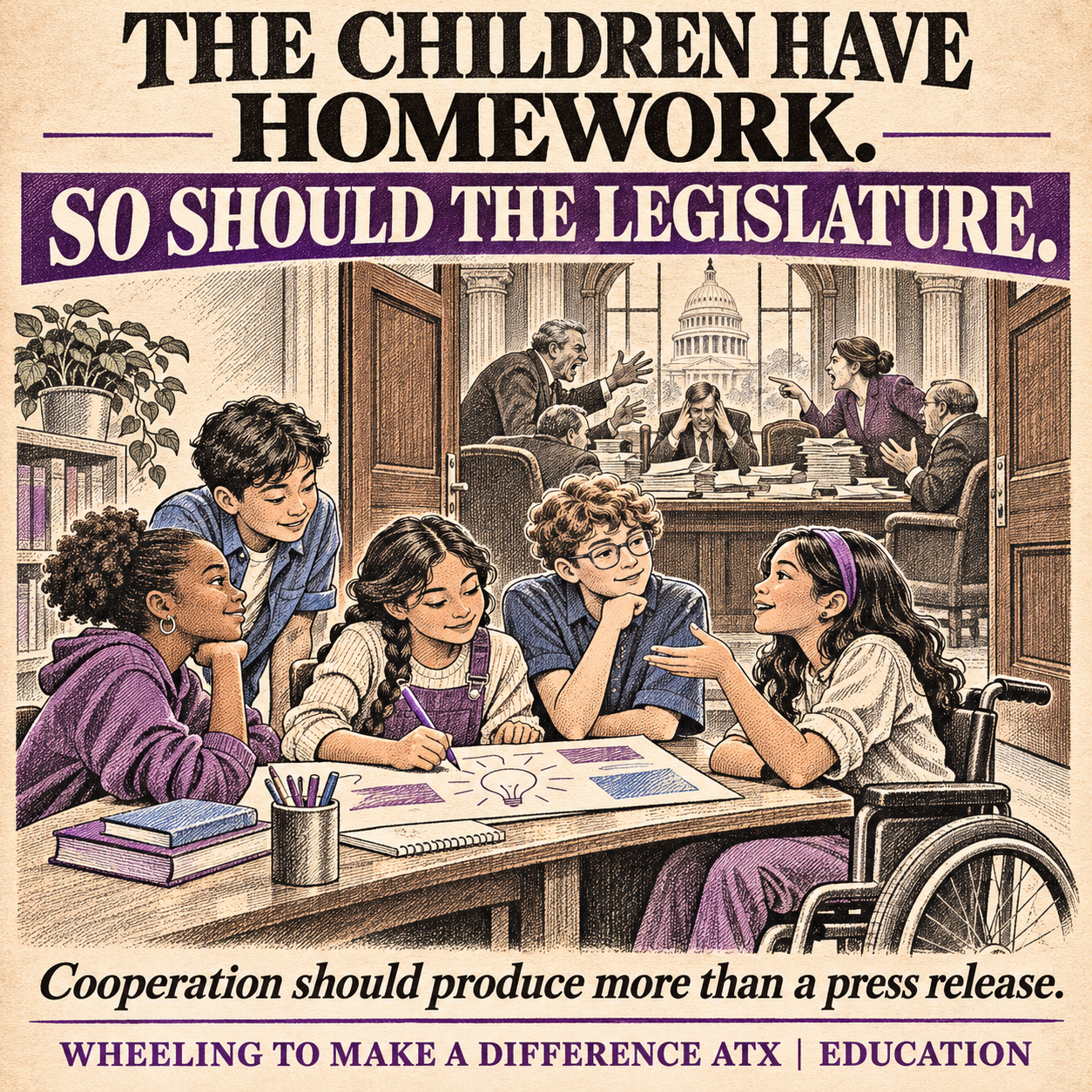
Republicans who promote parental choice should also be expected to fund the public schools families continue to choose. Democrats who defend public education should take seriously parents whose children need an immediate alternative. Neither party earns a passing grade merely by identifying the other side’s weaknesses.
But compromise is not automatically good policy. A bad proposal does not become responsible because someone calls it bipartisan. The standard should be whether lawmakers produce workable, adequately funded solutions and explain the tradeoffs honestly.
There is plenty of common work available: protecting dependable classroom funding, improving disability services, retaining qualified staff and making the budget understandable to the people paying for it.
An automatic inflation adjustment deserves serious consideration, alongside regular review of what schools need to serve students. Funding increases should distinguish genuinely new resources from tax swaps and temporary aid. New requirements should come with a clear explanation of who pays. Public reporting should show what reached districts, what restrictions apply and what remains unfunded.
Those are proposed standards, not a description of everything Texas currently guarantees. They would make it easier to judge results and harder to substitute slogans for them.
We ask children to complete group projects with classmates they dislike. Surely elected officials can manage a school-finance bill without requiring a sticker chart.
A choice can help a child without solving the larger problem
Vouchers and education savings accounts use public money to help families pay for education outside traditional public schools. Their rules differ. Texas uses education savings accounts, which can cover approved expenses beyond tuition.
For 2026–27, the Texas Education Freedom Accounts program lists a private-school award of $10,474 per participating child. Eligible children with disabilities and qualifying IEP documentation may receive up to $30,000. Funding is limited, and eligibility does not guarantee an award. [1]
For a family that can find an appropriate school and cover any remaining costs, that assistance may open a door that was previously closed.
We should be able to acknowledge that without declaring the entire policy a success before examining who can actually use it.
An award is not the same thing as an available seat. Families still need to know whether a school can meet their child’s needs, whether transportation is workable, and whether tuition and other expenses exceed the assistance. Rural parents also need an alternative within a reasonable distance.
The meaningful question is whether a family gains a usable choice.
For children with disabilities, the distinction is especially important. Federal IDEA rules generally do not give children placed by their parents in private schools the same individual entitlement to special education services they would have in public school. Some may receive equitable services, but that is a different arrangement. Parents deserve a clear explanation before making a decision. [2]
“Micro” does not necessarily describe the tuition bill
Microschools offer small learning communities, often with mixed-age groups and flexible instruction. Some operate as private schools; others support homeschooling. The label alone tells parents little about the schedule, services or voucher category. [9]
Their appeal is understandable. A smaller setting may give a child room to thrive. But parents still need to examine the price tag—and exactly what it buys.
Here is a sample of Austin-area schools’ published annual tuition, before financial aid, discounts and additional fees:
| School | Program | Annual tuition |
|---|---|---|
| Austin Micro School | Full-time, five days per week | $18,000 |
| Austin Micro School | Three / two / one day per week | $12,000 / $9,000 / $5,000 |
| Athena Micro-academy | Grades 6–12, full-time | $17,000 |
| Athena Micro-academy | Five mornings per week | $10,200 |
| Cathedral School of Saint Mary | Pre-K–8, first-child base rate | $8,500 |
| Hyde Park Schools | Kindergarten–grade 5 | $19,390 |
| Hyde Park Schools | Grades 6–8 / grades 9–12 | $24,500 / $29,740 |
| Waterloo School | Published annual tuition | $20,750 |
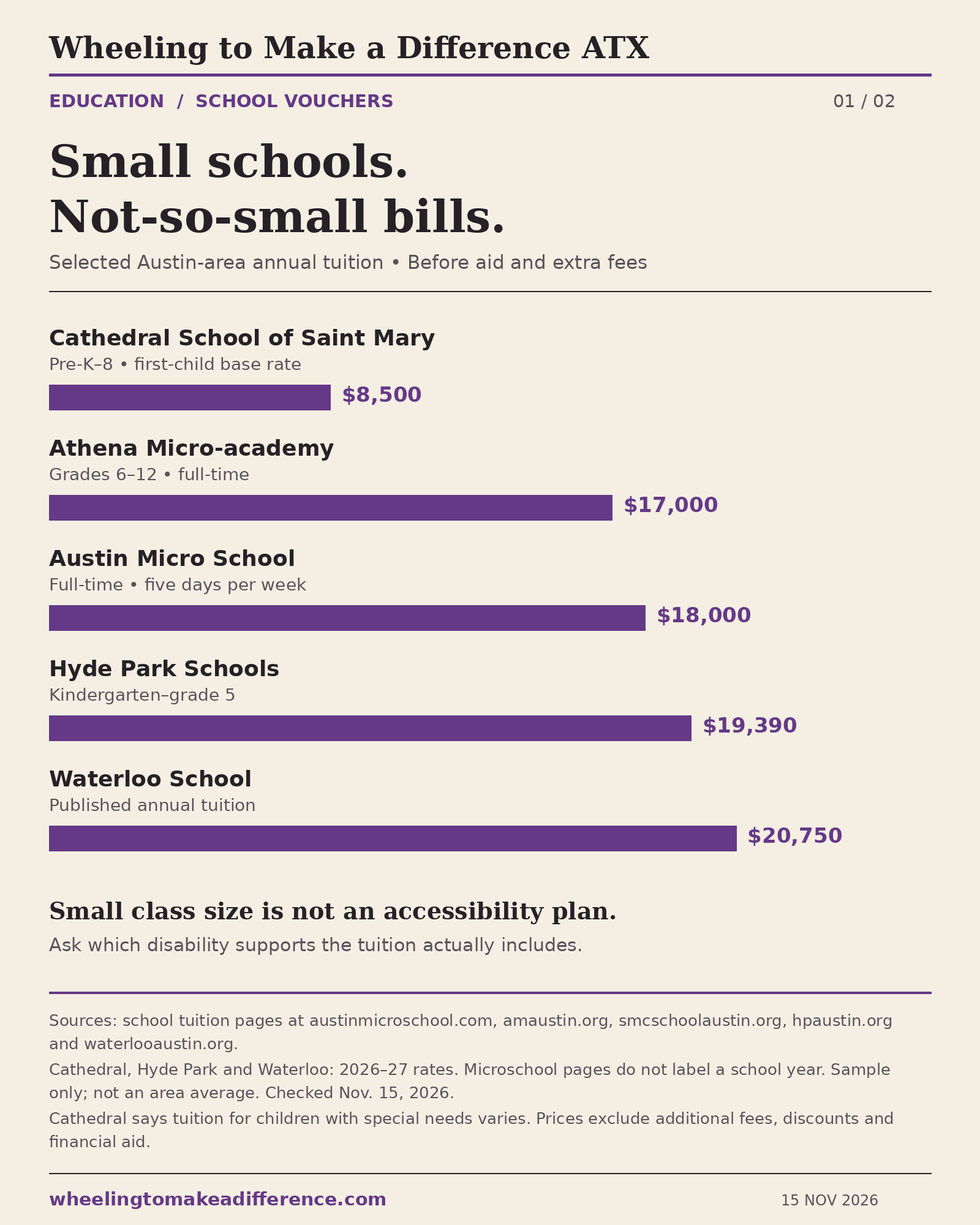
Prices checked November 15, 2026. Cathedral, Hyde Park and Waterloo identify these as 2026–27 rates. The two microschools’ pricing pages do not clearly label a school year. This is a sample, not a regional average or a confirmation of available seats. [10–14]
The less expensive part-time programs deserve a fair comparison: one day on campus is not five days of school. Families must still arrange learning and supervision for the remaining time. Savings on tuition may come with a substantial commitment of a parent’s time.
Even assuming a family receives the standard $10,474 award and can use it for an eligible enrollment, the arithmetic leaves meaningful gaps:
| Full-time tuition example | Tuition remaining after $10,474 |
|---|---|
| Austin Micro: $18,000 | $7,526 |
| Athena: $17,000 | $6,526 |
| Hyde Park elementary: $19,390 | $8,916 |
| Waterloo: $20,750 | $10,276 |
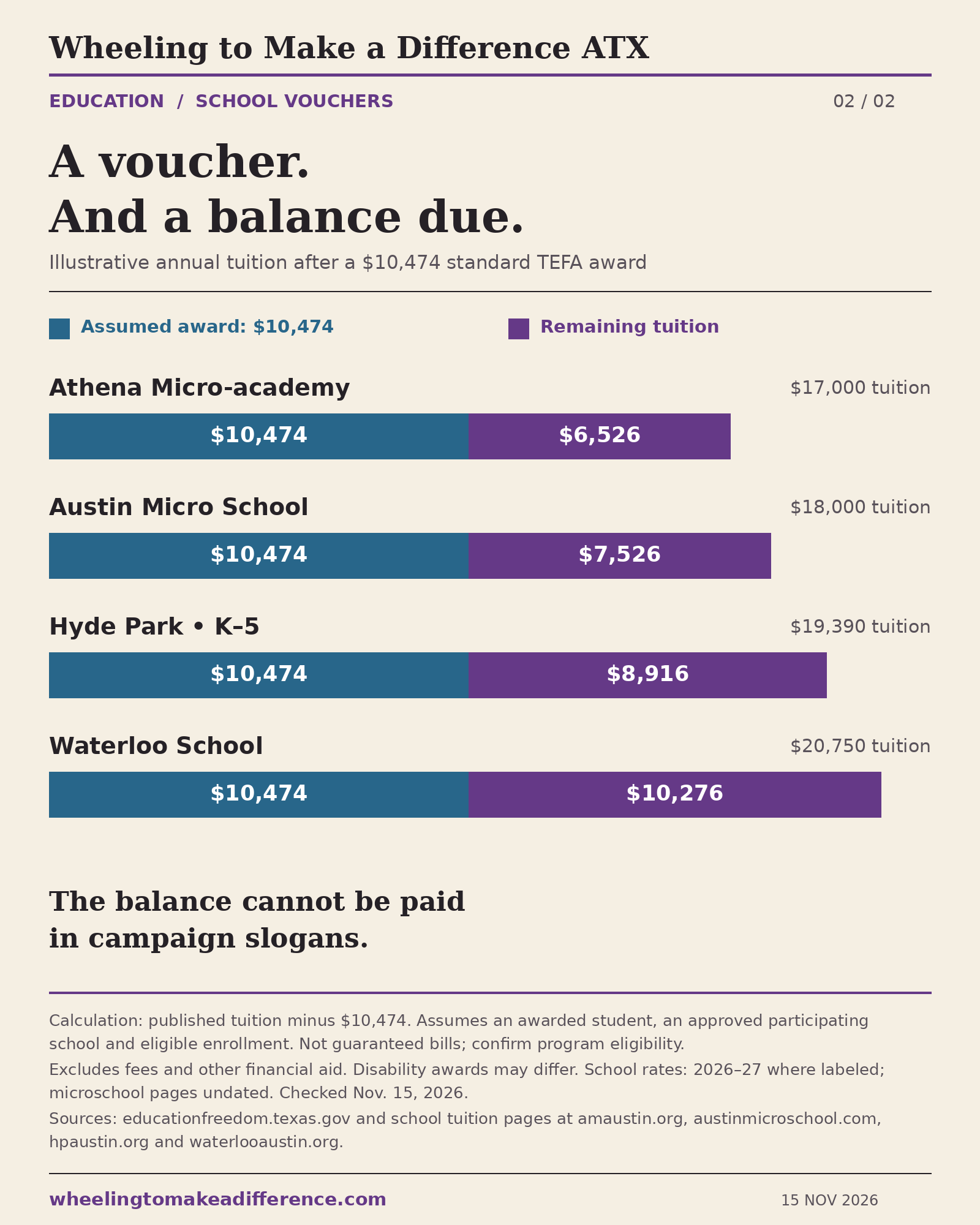
These are illustrative calculations, not guaranteed bills. They assume an approved participating school, an awarded student and an eligible enrollment arrangement. Fees and other financial aid are excluded. Austin Micro says it accepts TEFA; Athena describes itself as an approved vendor in Odyssey. Families must confirm the specific program’s eligibility. [1][10–14]
Some schools’ base tuition falls below the standard award, as Cathedral’s published rate illustrates. That matters: vouchers could make certain options financially reachable. But the base price does not settle every family’s bill.
Cathedral lists a $150 application fee and a standard $450 enrollment fee, and says tuition for children with special needs varies according to their needs. Athena lists after-school care at $350 per month and tutoring at $30 per half-hour for enrolled students. Austin Micro’s $500 enrollment payment is credited toward tuition, while summer camps cost extra. [10–12]
For families with disabled children, the question is more specific: Does the price include the staffing, communication support, accessible transportation, restroom assistance and other services their child needs? A small classroom is not, by itself, an accessibility plan.
Specialized schools also have different capabilities. Rawson Saunders serves students with dyslexia and identifies limits on the behavioral supports it can provide. Its public admissions page lists a $250 application fee and other expenses but does not publish a tuition amount I could verify directly. A school can serve one disability well without being equipped for every child’s needs. [15]
The state’s higher disability award is not an automatic $30,000 payment. It depends on qualifying IEP documentation and the funding calculation. And families in the homeschool/other category receive $2,000, making the enrollment arrangement particularly important for microschool comparisons. [1]
Lawmakers can announce a choice. Families still have to find an available seat, an accessible school and a way to pay the balance. Unfortunately, the remaining tuition bill cannot be paid in campaign slogans.
Parents should not have to choose between their child and everyone else’s
Supporting public education cannot mean demanding that parents accept unsafe or unsuitable conditions out of loyalty to a system.
At the same time, helping some families leave does not discharge the government’s responsibility to the children who remain.
Public schools cannot instantly shrink their expenses every time enrollment falls. A building still needs electricity. A bus route still needs a driver. Losing a few students across several classrooms may reduce attendance-based revenue without eliminating the cost of a classroom.
That does not mean every voucher dollar is mechanically subtracted from a district’s budget. The effects depend on program funding, enrollment changes and school finance rules. It does mean policymakers should account for those effects before promising that everyone wins.
A credible middle ground would pair parental options with sustained investment and clear obligations:
- Fund public schools according to actual needs and costs. That includes competitive pay, manageable workloads, special education, counseling and reliable transportation.
- Make choice usable. Examine affordability, distance, available seats and disability services—not just how many awards are offered.
- Require accountability wherever public money goes. Families and taxpayers should be able to examine spending, educational results, admissions practices and complaint procedures.
- Improve choices within public education. Transfers, specialized programs and timely intervention should be available before a family reaches a crisis.
More money alone will not resolve every school problem. Leadership, teaching quality and responsiveness matter. But expecting improvement while neglecting the resources required to deliver it is not accountability. It is wishful budgeting.
Working together means accepting that a useful policy might give someone from the other party a reason to smile. We can survive that. Children should not have to absorb another funding failure to protect an adult politician from an awkward campaign photograph.
Parents should have a meaningful voice in where and how their children learn. They should also be able to expect that the school down the road has the staff, services and stability to educate them well.
The goal should be a country where leaving is a genuine option—and staying is a good one.
The children already have homework. The adults at the Capitol need to do theirs.
Sources and reporting notes
- Texas Education Freedom Accounts: program amounts and eligibility.
- U.S. Department of Education: IDEA regulation 34 CFR 300.137. This discussion concerns parentally placed private-school students, not district-funded private placements.
- NCES, Digest of Education Statistics, Table 236.15. Historical comparison uses actual years, not the table’s projections.
- Center on Budget and Policy Priorities: A Punishing Decade for School Funding. Historical, inflation-adjusted state-funding comparison; not a claim about 2026 funding levels.
- The Texas Tribune: 2011 Budget Cuts Still Hampering Schools.
- The Texas Tribune: Texas’ school finance bill—here are the details.
- Texas Education Agency: 2025 annual report, House Bill 2.
- Texas Education Agency: HB 2 funding formula changes.
- National Microschooling Center: Defining Microschools.
- Austin Micro School: tuition and fees.
- Athena Micro-academy: tuition and pricing.
- Cathedral School of Saint Mary: admission information and tuition.
- Hyde Park Schools: tuition.
- Waterloo School: tuition and financial aid.
- Rawson Saunders: admissions and financial information.
- The Texas Tribune: Here’s what the Texas Legislature did and didn’t do for public education, June 2, 2023. Covers HB 100, the House proposal and the voucher stalemate.
- The Texas Tribune: Texas officials’ claim that school funding is at an all-time high ignores inflation and temporary federal money, March 28, 2025. Describes conditions before the 2025 funding changes.
- Texas Education Agency: Tax Year 2025 Maximum Compressed Tax Rates, June 12, 2025. Explains that Tier One compression changes the state-local shares, not total Tier One entitlement.


Leave a Reply